From Fleece to Facade
Jonathan Grinham’s GSD research group has turned leftover wool into a petrochemical-free system of insulation and cladding for retrofitting buildings. Fresh from the Oslo Architecture Triennale, he explains why reviving industrial systems matters as much as the material itself.
Sheep have been field-testing their insulation for millennia. And now Jonathan Grinham (DDes ’17), assistant professor of architecture at the Harvard Graduate School of Design, is finding ways to put surplus wool to work on the buildings we already have. At the intersection of design and science, his Grinham Research Group creates new materials from the molecular level up—research that extends across the university, from the Center for Green Buildings and Cities (CGBC) to the Harvard John A. Paulson School of Engineering and Applied Sciences (SEAS).
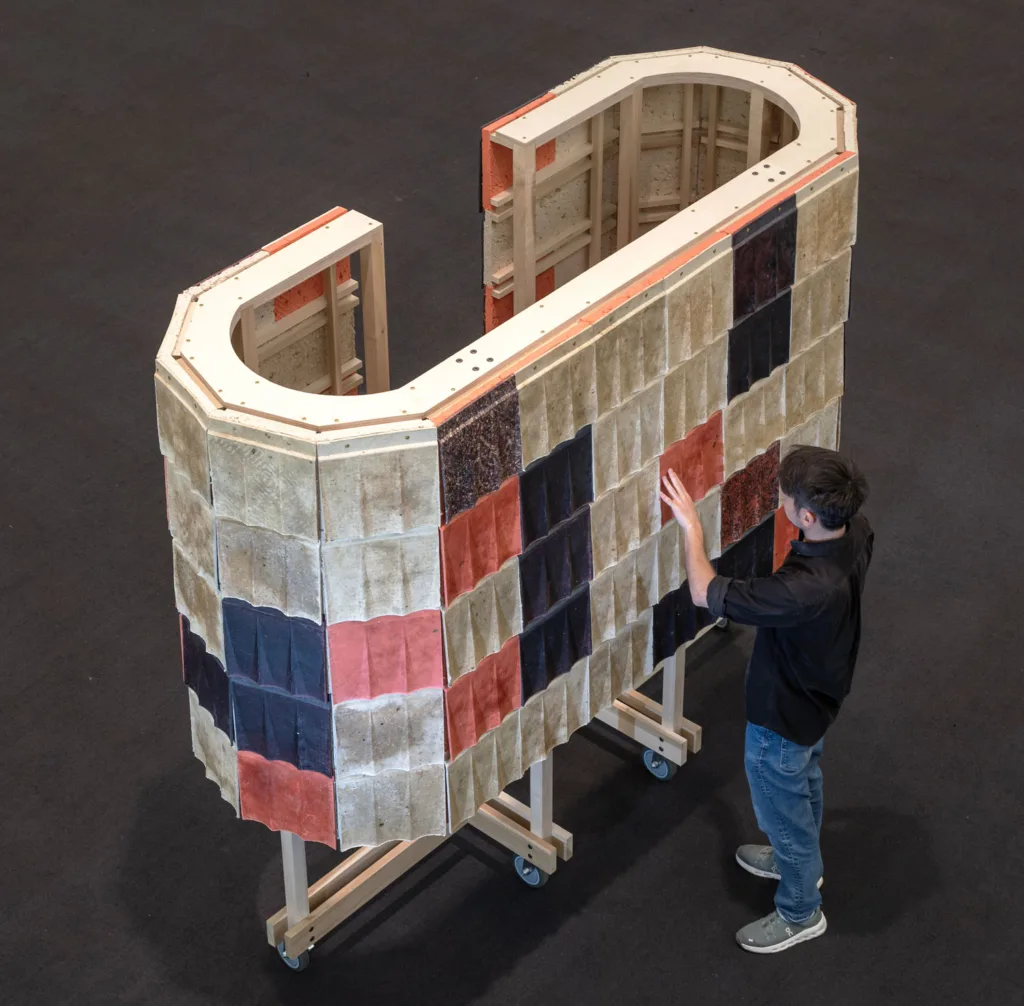
This September, Grinham brought this work to the 2026 Oslo Architecture Triennale, where he delivered an opening keynote and his group exhibited Upcycling Wool Ecologies. The installation answered the Triennale’s theme, What If Nature Comes First?, with a petrochemical-free system made from wool: an insulating layer topped by fluted, weather-resistant cladding, designed to retrofit buildings from the outside.
Speaking with A. Krista Sykes, Grinham traces wool’s journey from sheep to shingle, by way of a wool mill and a pulp plant, and makes the case that building the industries around a material matters as much as the material itself.
A. KRISTA SYKES
Your work is grounded in the idea of a regenerative architecture. What does that mean to you?
JONATHAN GRINHAM
We’re thinking about how material systems can be integrated into a more regenerative architecture practice, one that thinks about climate in a pluralistic way. What materials are we using? How do those materials sit within much broader systems ecology? And where can architecture become a leverage point to feed those materials back, to regenerate not only the environment but also the skill, labor, and industrial systems at risk of being lost?
KRISTA
Which brings us to wool. Your research notes that nearly two billion kilograms of wool are produced globally each year, and a fair amount goes unused. What helped you see wool’s potential for regenerative practice?
JONATHAN
I have family members who practice regenerative farming, and I’ve seen how it improves the soil, the grass, and the full ecology of a farm, while providing jobs and nutrient-rich food. That model was always attractive to me.
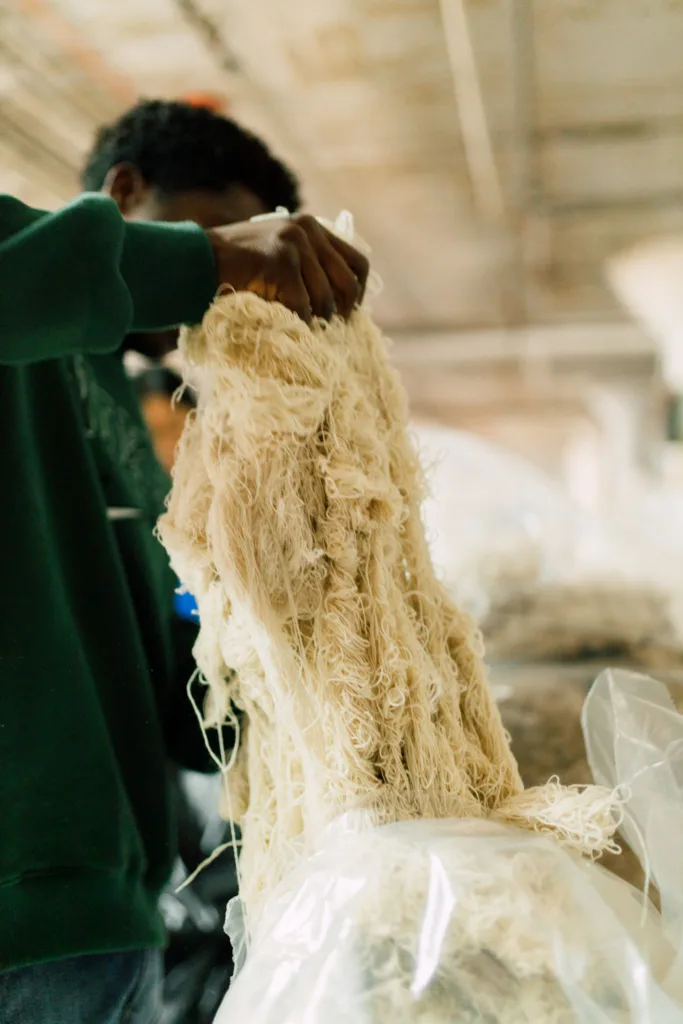
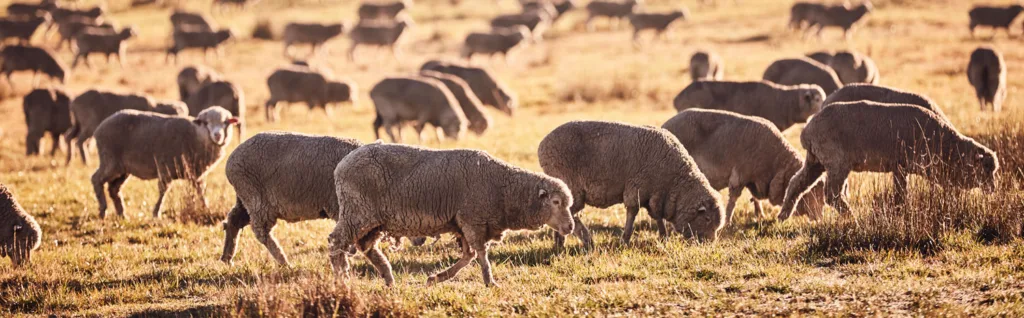
waste wool. Courtesy of
American Woolen Company.
Then, in the Master in Design Engineering program, we spent a semester focused on textile ecologies. Through colleagues like Karen Reuther, we connected with American Woolen Company in Stafford Springs, Connecticut, and specifically with Jacob Long. The previous mill, Warren Mill, had closed, and Jacob came in, built up the capital to purchase it, and has been working to revitalize the wool industry by reimagining its regional textile and apparel ecosystem.
Because the mill processes wool from start to finish, it generates pre-consumer waste as part of the industrial process, and Jacob has a fair amount of scoured, clean wool that he can’t put back into the system. That’s where we started: asking what can we do with this pre-consumer wool?
Then we asked, what’s the value of this wool? It may have lost its position within an economic market, but wool is a naturally derived polymer. Where are polymers used in buildings, and how might we not only displace those polymers but also improve the built environment while using that residual wool stock?
KRISTA
How does that wool find its way into architecture?
JONATHAN
In my research, we think a lot about how the flow of materials impacts climate, specifically the carbon they release or retain. One of the best things we can do is treat existing buildings as carbon and material reservoirs and retrofit them, bringing them up to the energy standards necessary to reduce operational carbon emissions.
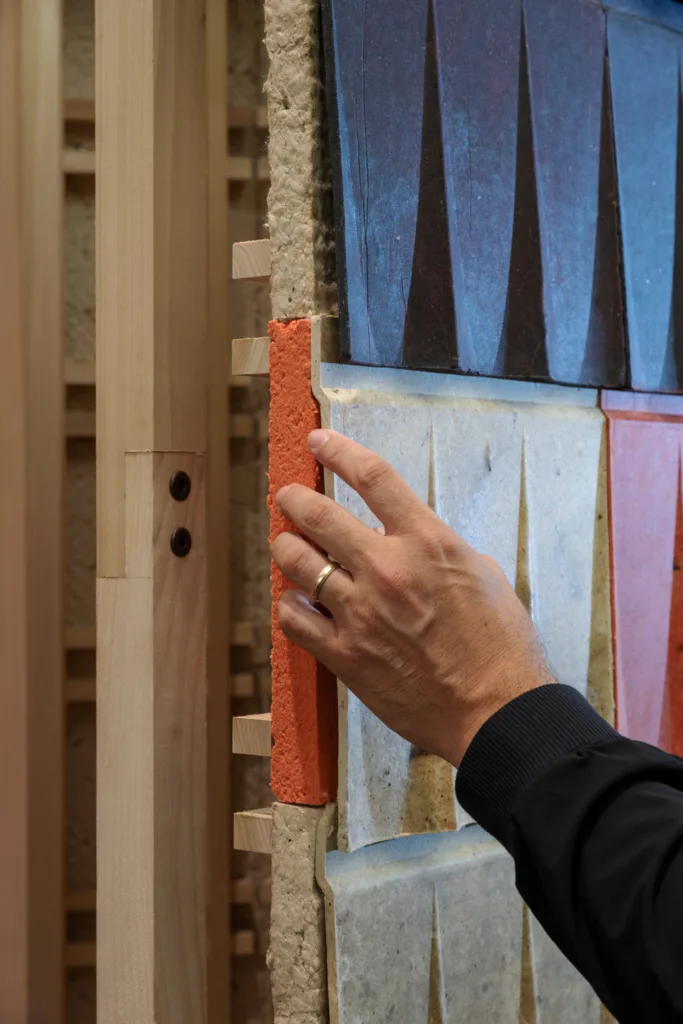
We know wool is a very good insulator; it’s been used in architecture, felted and otherwise, throughout human history. For the last decade, my group has worked within Joanna Aizenberg’s lab at SEAS, exploring the relationship between design and science. Through that collaboration, we’ve developed methods to break down the keratin, the protein that makes up the wool fiber, and reorganize it not only as an insulating material but also as a weather-resistant cladding. Leonard Palmer (MArch ’23), senior researcher in my group, has been instrumental in this work. The result is a system that can retrofit a building from the exterior.
KRISTA
Why retrofit from the exterior rather than the interior?
JONATHAN
Interior retrofits typically involve demolition, rebuilding, and displacing occupants, which makes them costly. An exterior retrofit avoids most of that. With the CGBC, we’ve been working to quantify what it takes to rehabilitate these buildings; that research indicates that working from the outside likely has a better return on investment in terms of both money and carbon.
KRISTA
Let’s go back to the material itself. How do you turn loose wool fibers into insulation and cladding?
JONATHAN
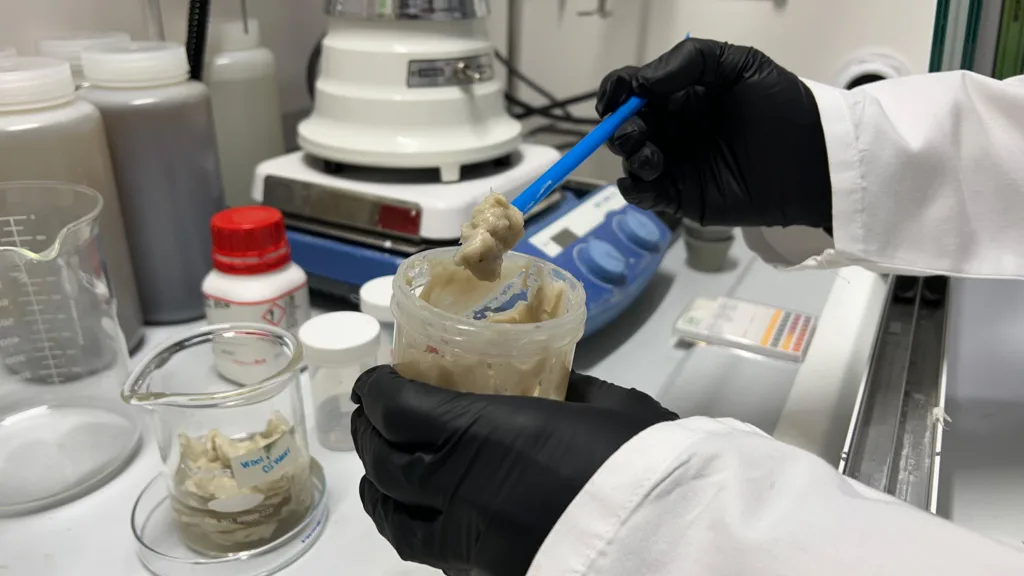
Ninety-five percent of the wool fiber is keratin, the same as our hair and fingernails. Fundamentally, it’s a polymer. We run it through a hydrolysis process that breaks down the fiber, stripping off the cuticle—the hard outer layer—and exposing the microfibrils and smaller polymer strands. That generates a polymer gel, which we can make into a film or recombine with residual microfibrils from our process. We then cross-link it with an organic acid to make a structural biocomposite. By controlling the polymer chemistry, we can make that biocomposite more rigid, more waterproof, or more insulating.
Notice I haven’t mentioned petrochemicals. There are none in the system we’re making. The final product is completely bio-derived.
KRISTA
A completely bio-derived material is a breakthrough. Then comes the question of scale. How did you take it beyond the lab?
JONATHAN
For the Oslo Architecture Triennale, we had to go from working with maybe 100 grams at a time to industrial volumes. So we turned to the pulp and paper industry. A pulp mill does something very similar with wood fibers, using comparable chemistries along with heat and energy from mechanical pulping machines, which meant we could break down the wool on the same equipment. Working with the pulp and paper pilot plant in North Carolina State University’s Department of Forest Biomaterials, we processed more than 200 kilograms of material this summer, which became Upcycling Wool Ecologies—our contribution to the triennale.
KRISTA
Upcycling Wool Ecologies translated this research into an experience for the public. What did you hope visitors would understand or reconsider when they encountered this installation?
JONATHAN
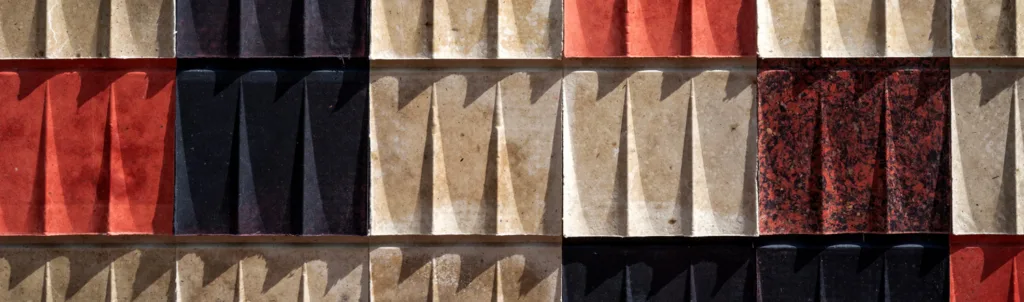
There are two levels to this. First, we still wanted to think about form and aesthetics. We presented a playful form that exhibited a retrofit solution in all of its components; it floated in a speculative space, taking the shape of an occupiable agricultural stock tank, and visitors could move around it, explore it, and step inside it to experience the acoustic damping provided by insulating panels. We articulated the weatherized panels with a fluted geometry to express formal possibilities, saying, look, we’re working with a polymer, and just like most plastics, we can easily shape it into any form, while giving it structural depth and texture.
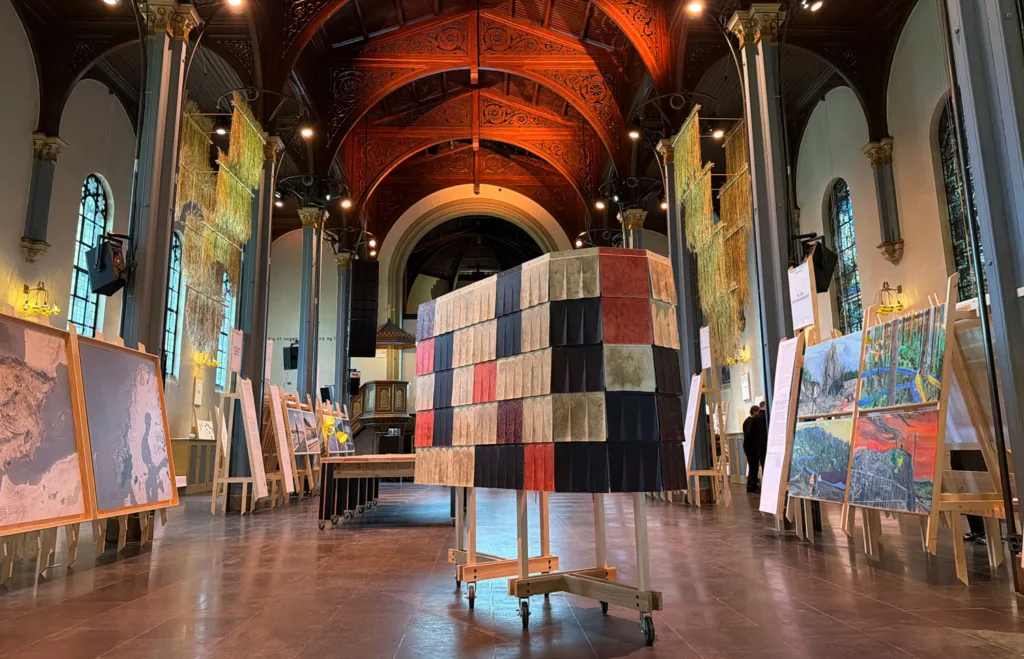
The exhibition element is also speckled with red, blue, and white panels because some of the pre-consumer wool from American Woolen was dyed. That’s an aesthetic decision, but it also references the potential for a post-consumer product.
Second—and this may not have come across immediately, but we hoped our surrounding collateral conveyed it—is the connection back to an industrial ecology. Many folks are rightfully investigating new biomaterials and mineral materials to reduce carbon emissions and the need for extraction. But for me, any new material still needs to work within an industrial system. Making one piece at 100 grams isn’t going to change things, but if we can reorganize the industrial ecology around the material so that we can scale it and productize it, there’s potential for change. For wool producers, we hope that means a place for their unused, lower-quality fibers to go into the building—storing the carbon in that fiber, improving the performance of the building, and potentially retaining their jobs and their skills.
KRISTA
You mentioned keeping wool producers’ fiber and skills in use. What does bringing the paper industry into the picture mean for pulp mills?
JONATHAN
This is the part that’s really special. Like the wool industry, the paper industry is contracting; in the last two decades, half of all pulp mills have closed globally. Yet both industries still have an incredible amount of skilled labor and know-how, and we’re tapping into that by bringing the two together.
For the mills, we think it’s an opportunity to co-locate a production line with a secondary product that helps keep those jobs. And co-location is intriguing because you’re not necessarily building out new capital; you’re integrating with existing systems.
KRISTA
How does the new product stack up against what’s already on the market? What does this material do that conventional insulation or cladding can’t?
JONATHAN
So much building insulation is made from petroleum-based plastics like polystyrene. Beyond the extraction and carbon involved, we’re becoming much more aware of the health consequences related to these chemicals. Wool offers a polymer that nature provided first. Its keratin is used in the biomedical industry because it’s biocompatible with our own bodies, so a building made with it may be more compatible with the people inside. As healthy building standards emerge, this gives a wool-derived polymer an edge.
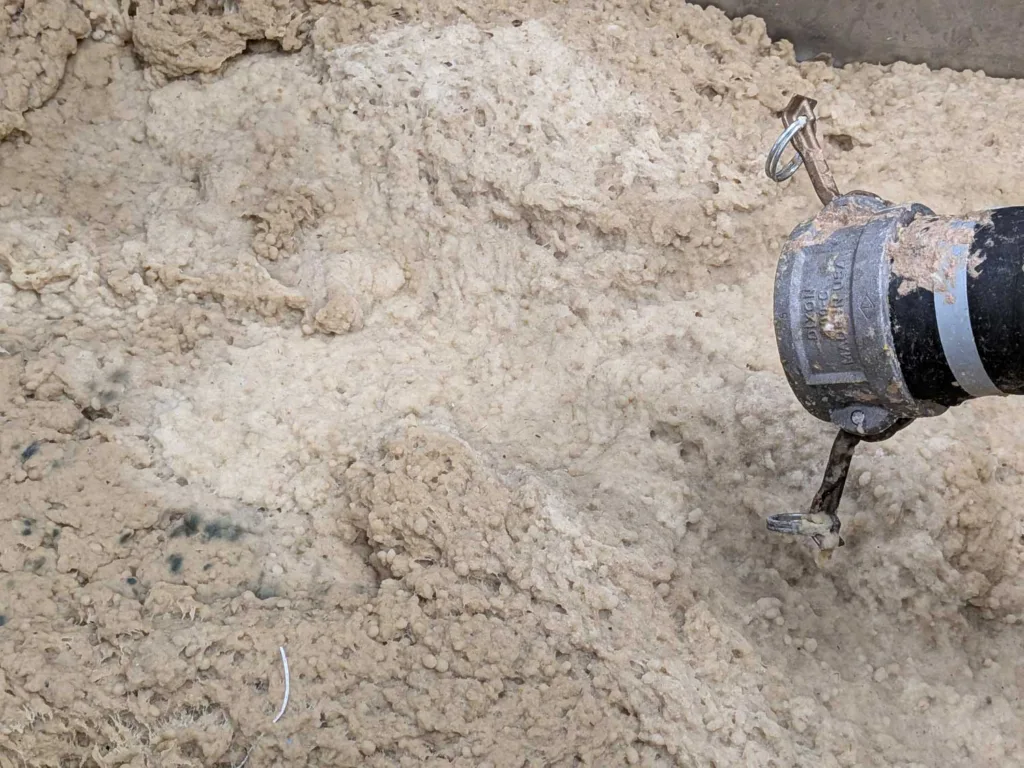
pulper at the Pulp and Paper Pilot Plant, North Carolina State University. Photo: Grinham Research Group.
Others are also replacing petrochemical insulation with bio-based alternatives like wood fiberboard, and I think those products are great. TimberHP, for example, makes a wood fiber insulation that stores biogenic carbon. Wool and wood are both about 50 percent carbon; whether you follow that biogenic carbon from the grass or the tree, you’re storing it in the wall—something petrochemicals can’t do.
Where we differ is the system. Wood fiberboard insulates, but it sits within a different construction system and needs separate cladding. With wool, we can make both the insulation and a durable, weatherized cladding on top of it, so a building can be retrofitted from the outside within a single product system.
KRISTA
Which buildings are that system best suited for, and who is helping you think through the market?
JONATHAN
When we talk about retrofit, we always reference this stat: almost fifty percent of US homes were built before energy standards were introduced in the 1970s. That’s an enormous stock to upgrade. But that’s where the leverage is, designing needed, widely dispersed building products with large material flows. So, we’re targeting homes as a starting point for the market.
Figuring out that market has been a collaborative effort. Through Jacob, we’ve connected with a much wider network in the wool industry. The American Wool Council and the Woolmark Company have been big supporters, providing resources and feedback. Draper Knitting in Canton, Massachusetts—six generations of knitters—introduced us to the R.H. Lindsay Company, a fourth-generation wool broker, and talking with both groups has helped us understand whether we can do this at scale.
Autodesk has been a key supporter, too. We’re residents in their Technology Center for another project, and for many years, we’ve been sharing this research with their Net Zero Buildings research group, which has introduced us to a larger network of people working on circularity and materials. Alongside our wool and paper partners, Autodesk has been our sounding board on the architectural side, curating conversations and bringing in others to give feedback.
KRISTA
Bringing a new material to market is rarely simple. Are there trade-offs or limitations you’re still working to address?
JONATHAN
Scalability is a big one. There’s an incredible amount of wool, but there’s still orders of magnitude more wood-fiber cellulose out there. Sheep ranching raises questions, too, since sheep are high carbon producers themselves, and emissions typically get attached to the wool. That’s where the project’s agricultural roots come in. We look at the whole, land-based system: When sheep are raised regeneratively, grazing can help draw carbon into the soil, our best carbon sink after the ocean. The question becomes: Can our system help reinforce that more regenerative response?
We’re also still exploring technical questions, like just how weather-resistant the cladding can be. We know you could paint it, but that reintroduces petrochemicals. Right now, our research shows that, untreated, it performs as well as cedar siding.
Another fascinating aspect is that, through its own chemistry, wool is naturally flame-resistant. Given the fire-prone regions at the wildland–urban interface, that’s really exciting to us. Our early studies are promising, but we need to take the cladding to industry to demonstrate its fire resistance and fit it within the complicated policies and codes for buildings.
KRISTA
Beyond the material itself, what do you hope people take away from this work?
JONATHAN
For me, what’s most special is the network and the collaboration. That’s why I wanted to name everyone we’re working with here.
As designers and educators, we write papers about regeneration and theorize it in class, and that work is valuable. This project lets us take those ideas further and test them in practice. In the process, we’re offering a model for how to rebuild the industrial ecologies that connect architecture with these other industries.
I just can’t stress enough: The doing matters. Architects make things, and here we’re innovating from the molecular level of keratin up to the regional scale, working across New England and North Carolina, and reaching an international audience in Oslo.