Heat Waves as a Social Autopsy of the Built Environment
In Paris, the emergency department bears the brunt of a housing system under thermal distress.
“It’s an oven,” is the phrase I hear most often from the Parisian residents, urban planners, and hospital teams with whom I work. Under zinc rooftops, in poorly insulated homes, a fan stirs hot air, sleep becomes rare, chronic illnesses decompensate. In inner Paris, four out of five buildings have a pitched roof, most often in zinc, and these roofs cover nearly 40 percent of the built surface. In summer, zinc can reach 80°C. Meanwhile, only technical areas in hospitals that require a stable temperature, such as operating rooms, intensive care units, and laboratories, are systematically equipped with air conditioning. In the face of heat waves, public facilities are significantly behind, which led the government to place an urgent order for 30,000 portable air conditioners this summer.1 That led to trolleys piling up in emergency corridors, newborns overheating in rooms with no air conditioning, and geriatric wards unable to bring comfort to recovering patients who sometimes have to live in these hospitals for up to a few months. The French hospital becomes both a thermometer of social inequalities and a shock absorber of political procrastination on housing and urban planning.
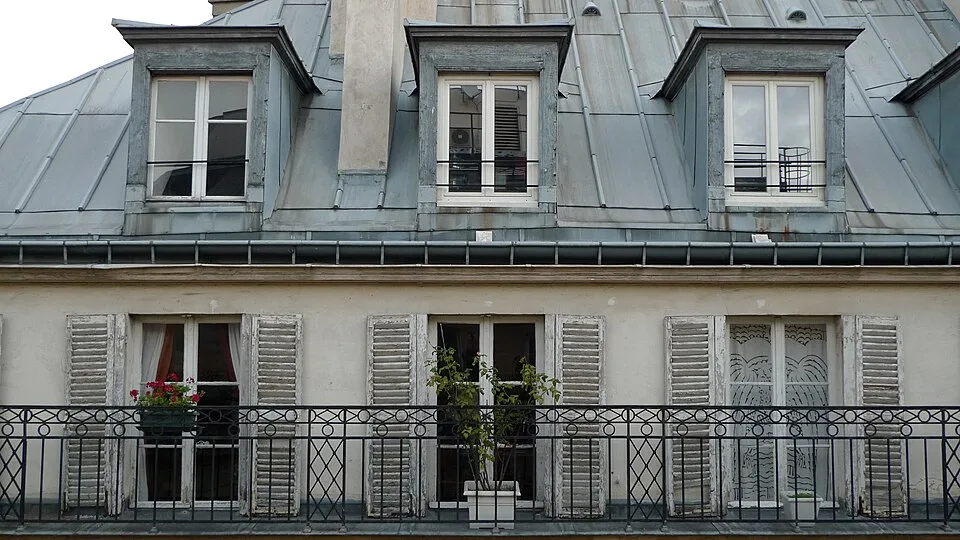
Heat in these built typologies is more than a discussion about discomfort; it’s a public health risk that has been apparent for decades. In August 2003, a 20-day heat wave caused nearly 15,000 deaths in France, including more than a thousand in Paris, with excess mortality of 143 percent in the capital, compared with 25 percent in Marseille.2 The post-crisis assessments showed that roughly one in ten deaths in Paris concerned residents of uninsulated apartments, notably in top floor units. Research on “moving environmental justice indoors” takes on its full meaning here.3 Climate injustice plays out not only floor by floor, but also from one municipality of greater Paris to another.
Two decades later, the metropolis has equipped itself with new tools. Yet, because they are not always well-designed or -implemented, they can reinforce the inequalities they claim to correct. To shed light on this paradox, I propose a triptych of public health approaches that is both analytical and operational: health capital, health contract, and health commons.
Health Capital: Who Can Protect Themselves from the Heat?
According to a pioneering study by the Atelier parisien d’urbanisme, in 2003, Paris had 113,000 top floor units.4 France’s National Institute of Statistics and Economic Studies (INSEE) has since revised this figure downward, with 90,000 such rooms recorded in 2022, due to the merging of units. The households living there today occupy expensive, poorly insulated homes that are difficult to retrofit because of regulations and co-ownership rules.
These are, above all, households with limited health capital. One in three dwellings in the country is a thermal kettle, and Paris is no exception.5 All are generally occupied by low- or middle-income households.6 With each new heat-wave episode, these vulnerabilities translate into an increase in emergency room visits for heatstroke, cardiovascular decompensation, or respiratory disorders, which hospitals must manage in facilities poorly adapted to extreme temperatures.
In many public hospitals, cooling systems are partial, obsolete, or designed for short, moderate peaks rather than repeated waves of 40°C heat. Corridors and shared rooms become stifling, operating rooms must sometimes reduce activity during the hottest hours, and staff themselves suffer from dehydration and exhaustion. The emergency department therefore becomes the final buffer of a housing system that exports its thermal distress directly into the health system. By failing to act on these thermal kettles, we reallocate risk according to households’ health capital.
One way forward is to target thermal kettles, by cross-referencing building type, floor level, energy performance rating, and social and health vulnerability, including distance to healthcare facilities and an indication of the level of adaptation of hospital infrastructure. This implies mapping not only where at-risk people live, but also which hospitals and clinics are structurally capable of receiving them in conditions compatible with extreme heat: double-checking ventilation, shading, backup power for cooling systems, and the availability of dedicated cooling rooms. This connection between the degree of adaptation of homes and that of hospital facilities is rarely integrated into decision-makers’ analytical grids.
Health Contract: What Do We Promise Residents?
We owe the concept of “social autopsy” to Eric Klinenberg, who showed, based on the 1995 Chicago heat wave, how a heat wave can reveal the hidden workings of a city, including its degree of racial segregation, ingrained economic inequality, and unequal levels of exposure to public health risks, as well as its informal networks of solidarity and mutual aid.7 We can now read each heat wave as a “social autopsy” of the implicit contract between the metropolis and its inhabitants—who is actually protected, and who is not.
After 2003, this contract evolved: implementation of heat wave plans, identification of isolated elderly people, integration of heat risk into certain public health policies and into hospital emergency plans blancs (white plan) procedures.8 In France, successive heat wave plans have also given hospitals protocols for activating “level 3” and “level 4” alerts, opening cooling rooms, postponing non-urgent procedures, and reinforcing staff in emergency and geriatrics. But, these protocols often collide with chronic understaffing, bed shortages, and aging buildings. When the plan is activated, it is the same exhausted teams and the same overheated wards that must absorb a surge of patients from the most exposed neighborhoods.
The 2021 Loi Climat et Résilience, municipal climate plans, and hospital plans blancs, are all attempts to govern climatic uncertainty through standards, labels, and emergency mechanisms. But, there’s the rub. In Paris, real estate transactions from 2020 to 2025 show that the Loi Climat et Résilience mainly triggers the sale of small dwellings, which are then repositioned into high-end co-ownership, prop-tech investment products, or tourist rentals, rather than leading to a genuine acceleration of renovations, especially where insulation and heritage constraints are costly.9 Without the anticipation of profits from a sale, landlords often lack the incentives or resources to renovate and adapt these thermal kettles.10 And, in the case of hospitals, national emergency strategies and the turn to bioclimatic design solutions for new campuses does not fix the problem of the chronic crisis of obsolescence for the older French hospital infrastructure.
Health Commons: Buildings, Rules, and Data as Shared Infrastructures
In the face of heat waves, infrastructures like homes, hospitals, or schools, become supports for either risk or protection for the population. In Paris, many of these infrastructures were built or renovated for winter comfort, with sealed facades and large glazed areas that turn into greenhouses in the summer. At hospitals and schools, investing in shading, vegetated courtyards, passive cooling, and resilient energy systems within these built environment typologies, in addition to accepting that AC should be installed when necessary, would better protect patients and staff. These interventions, for example, in the same vein as the Notre Dame Cathedral garden redesign completed by GSD professor in practice of landscape architecture Bas Smets, would also serve as the visible symbol of a city that takes seriously the thermal risks it asks its inhabitants to endure. Discussions about recent hospital construction projects favor bioclimatic solutions rather than generalized air conditioning, as is the case for the future CHU university hospital of Nantes, scheduled for completion in 2028.
Hospitals, schools, and even homes must be understood as infrastructure to support the population during heat waves. Decisions about this infrastructure cannot be left to private owners and investors, and individual institutions cannot be expected to face the problem alone.
This summer produced images that we’ve seen before: burning forests, exhausted fans, temperature records, hospital corridors where people are suffocating. But through the prism of health capital, the health contract, and health commons, another potential narrative emerges: that of a greater Paris where vertical segregation, territorial fractures, and hospital fragilities adapt to the climate policies of the 21st century.
This research has been supported by the Dean’s Junior Faculty Research Grant Award and the Harvard Center for Green Buildings and Cities.
- No official figure records the exact number of hospitals without air conditioning in France.
- Rapport de la commission d’enquête parlementaire sur la canicule (Assemblée nationale, n° 1455, tome I, 2004); D. Hémon, E. Jougla. “Surmortalité liée à la canicule d’août 2003 en France,” BEH No. 45‑46, (2003), Inserm / InVS.
- G Adamkiewicz, AR Zota, MP Fabian, T Chahine, R Julien, JD Spengler, JI Levy, “Moving environmental justice indoors: understanding structural influences on residential exposure patterns in low-income communities,” American Journal of Public Health (Dec 2011, Supplement 1), pp. 238-45.
- APUR, Les chambres de service à Paris: 85 % sont inhabitées—Un potential pour développer l’offre de logement? (November 2015).
- Fondation Pour le Logement. “Des députés de huit groupes politiques déposent une proposition de loi sur les logements bouilloires initiée par la Fondation pour le Logement,” (June 6, 2025).
- La performance énergétique du parc locative privé au 1er Janvier 2023 (February 20, 2024).
- Eric Klinenberg, Heatwave: A Social Autopsy of Disaster in Chicago, Second Edition. (University of Chicago Press, 2015).
- The contract also includes adaptation subsidies such as the 2020 MaPrimeRénov’; the 2021 Loi Climat et Résilience (Climate and Resilience Act); the 2024 Paris bioclimatic local urban plan (PLU); and the climate plans of neighboring municipalities.
- Magda Maaoui, “Sous les toits: habiter à l’ère du réchauffement climatique,” AOC (December 15, 2025).
- Landlords often refuse to finance the renovation of thermal kettles, because so many of them are rented out and do not function as primary residences. And when landlords are willing to renovate, they face two obstacles: (1) their co-op neighbors often refusing any AC installation or structural renovation work in the building, or (2) the Paris building code or heritage regulations making it impossible to make any alterations to roofs, façades, envelopes, or window structures.