Between Tech Optimism and Anti‑Capitalism: Nancy Fraser and Bill McKibben at the GSD
Over the past few weeks, the Harvard Graduate School of Design has been animated by several conversations addressing the climate crisis, in part catalyzed by two visitors: Bill McKibben, the longtime climate activist, and Nancy Fraser, philosopher and critical theorist.1 They did not speak in dialogue with each other, but the proximity of their visits was nonetheless illuminating, and the contrast between their positions raised several questions about how designers might think about their role in the climate crisis.
McKibben’s argument was intentionally (and perhaps somewhat aggressively) optimistic. The energy transition, he told us, is already underway, and it may even be easier than we have thought it to be. In his view, the work to be done now is to lean into the evolving technology and trust it. Given the state of global affairs, one might be tempted to doubt the rosiness of this picture, but McKibben offered a seemingly inexhaustible store of facts and figures to support this position. The bottom line was this: the deleterious side effects of producing renewable energy technology pale in comparison to the effects of global heating, so there should be no debate about renewables.
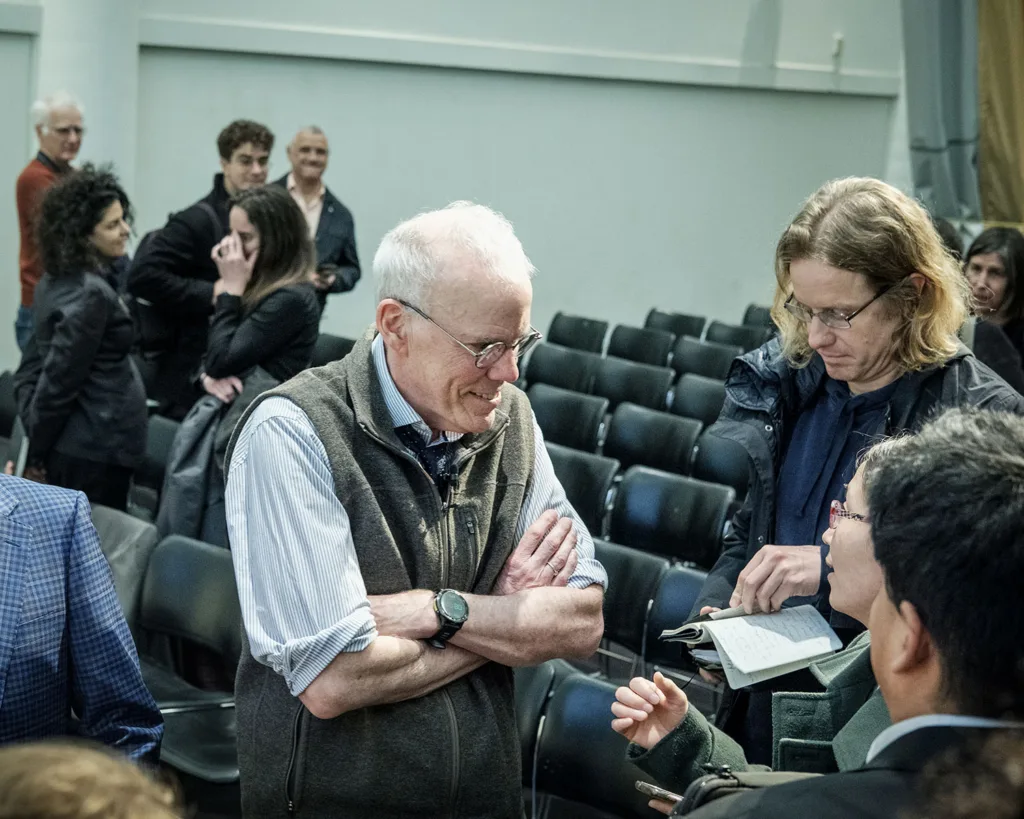
In many ways, the facts were compelling. And we are all eager for a bit of good news these days. However, by framing his talk through this lens, McKibben missed the opportunity to engage the specific positions and capacities of his audience: a room of designers, scholars, and students of the built environment, who likely do not need to be convinced about the merits of renewable energy sources.
To be fair, I suspect that this position on McKibben’s part is largely strategic, rather than ideological. He has spent decades combatting climate denial and working tirelessly against the lack of political will that now seems baked into American governance. Given the narrowing timeline available to avoid the worst outcomes, I can understand why someone in his position might choose to throw all their weight into the domain in which meaningful gains seem most attainable. There was, in this sense, an uncompromising realism in McKibben’s approach. And yet, it was precisely this realism that reduced the terms of the debate, evading and obscuring the thorny sociopolitical dimensions of energy transition. For example, the sole focus on improvements in energy technology locates agency almost exclusively within the realm of tech developers, bankers, and investors. Anyone not part of this elite cadre is left with nothing more to do than cross one’s fingers and hope that the tech development will properly run its course.
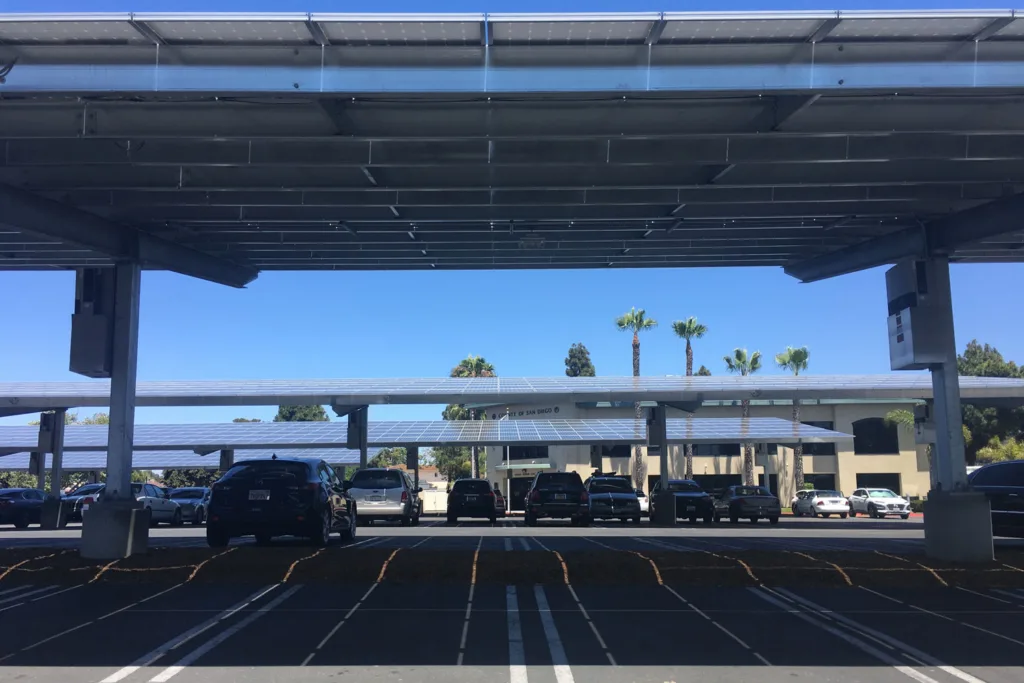
Delivered to a room full of designers, this message has a further implication: that the current way in which built form is produced can be left intact. If wind and solar can carry us through toward “a fresh start for our cities” (the title of the lecture), then there is no need to mention (let alone critique) conventional processes of construction and development. This attitude towards built form was made vivid when McKibben offered as a hopeful harbinger of change the image of a single solar panel installed on an apartment balcony, meant as an illustration of how energy transition can happen without fundamentally altering buildings. He meant this as good news—this will be easier than we thought, he seemed to say—but it suggests that energy transition is hardly a project of structural transformation. Rather, it is a technological overlay over existing spatial and social forms, and any mandate to build differently going forward can be cast aside.
Yet there is no question that the adoption of fossil fuels has produced a specific spatial and material order, one that holds an energy-intensive society in place. Furthermore, architecture, planning, and design have been central to its formation. To give one of many possible examples, the Modernist urban project was dedicated to creating new urban forms that would allow a nascent industrial paradigm to function better. Through the power of spatial organization, architects and urbanists sought to decongest pre-carbon cities, rewriting the dominant urban order to accommodate the speed and flow of mechanized mobility. This produced a spatial paradigm I call carbon form, and it is still in place, holding steady a certain threshold of energy consumption. To leave these configurations of space and form unchallenged is, in effect, to normalize a particular stance towards energy use. McKibben’s framework was far too limited to take any of this into account. For an ostensibly action-oriented thrust, to a room full of designers, it conveyed a different message: carry on, do not change.
Nancy Fraser, the 2026 Senior Loeb Scholar at the GSD, took a different approach. As a critical theorist and philosopher, her position was inherently analytical and diagnostic, and did not prescribe immediate action. This is not to say, however, that she was indifferent to what forms of action might follow.
Her argument, in essence, was this: the pillaging of nature is not an accidental side effect of capitalism but an integral feature of its logic. Drawing from Marx, who argues that capitalism must expropriate and appropriate resources before they are commodified, otherwise profit is impossible, she expands this framework beyond social reproduction alone to encompass extraction, ecological destruction, and the systematic subordination of the natural world to the demands of accumulation. The implication is unambiguous: meaningful climate action cannot leave that logic intact. It must be, at its root, anti-capitalist, and it cannot isolate the environmental struggle from the structural issues of labor and production.
From the outset, I found this far more satisfying, if only because Fraser is looking to operate on the underlying causes of the crisis. Furthermore, her structural approach inevitably raises the question of labor. One of the most powerful moments of her lecture came when she described the relationship between labor and non-human nature: while capitalism aims to separate labor from nature in order to isolate it and render it commodifiable, the separation can never be fully achieved, since, she argues, “nature and labor are internally related.” Nature supplies the raw materials that labor transforms, the energy that powers labor, the environmental conditions, and the “setting and site” in which labor unfolds. “Absent nature,” she puts it plainly, “there is no society, hence no social labor.” To see them as oppositional is “the structurally implanted illusion of a perverse social system.” The true complement of labor, she concludes, is not capital, but nature.
I love this formulation, which, unlike McKibben’s approach, posits an urgent question to the design disciplines: how might our labor—which, in the context of the profession, is not only commodified, but systematically directed towards capital accumulation due to its role within the real estate economy—draw itself back into dialogue with its neglected environmental context?
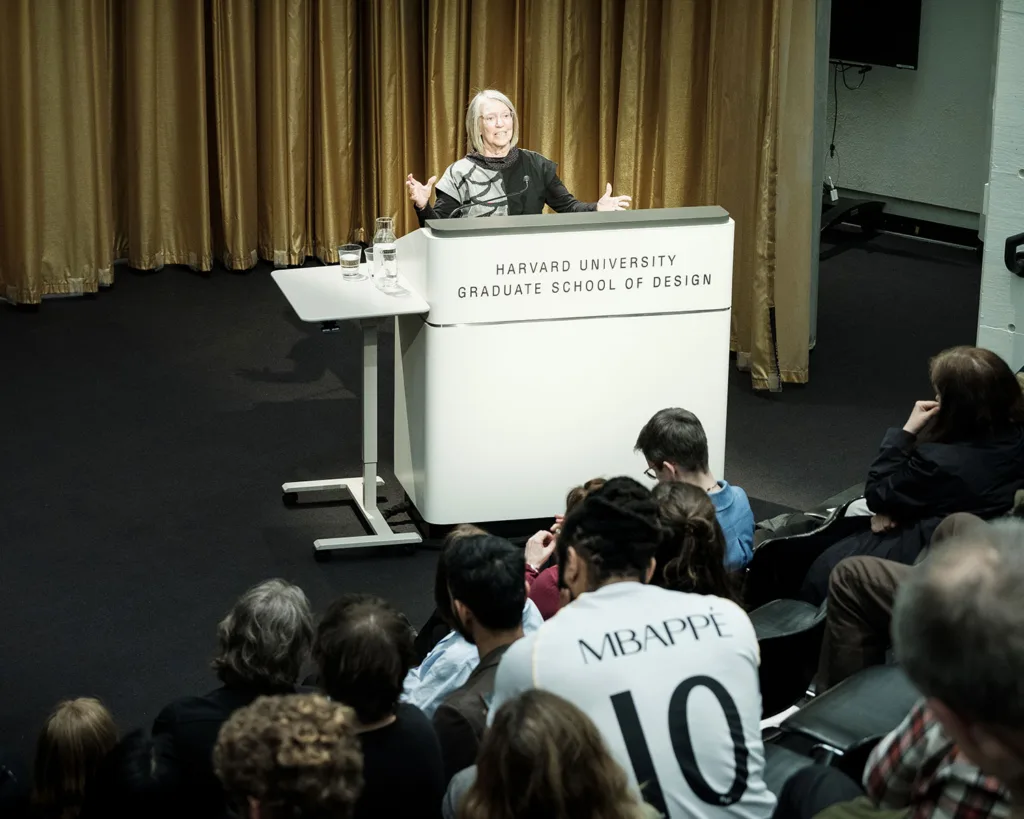
The answer is difficult to imagine, given that the ongoing dismemberment of the public sector leaves private capital as the primary engine for construction. Fraser, however, when pushed to offer insight into this question, focused less on the ways in which architectural and design labor are captured by capital, and expressed interest instead in architecture’s capacity to bear on the qualitative aspects of transformation and change. The coming changes, she insisted, will require new kinds of spaces, new kinds of institutional arrangements. She cites William Morris as an example of a designer who was engaged in precisely those questions, contributing to social change by proposing new configurations of social relations, labor, and space itself. Over the course of the Q&A, she was pushed to speculate on the contours of what comes next. Her reply: “people sitting in this audience are much better placed to think about those things than I am. I am a specialist in criticism; you guys are going to be the specialists in imagining the alternative.”
In this response, Fraser locates a form of power in design itself, in its capacity to configure and prefigure alternative social worlds. It leads to a crucial distinction: while the entanglement of the architectural profession with capital is unquestionably problematic, the limits of the profession should not be confused with the boundaries of the discipline. In other words, architectural thought exceeds the pragmatic delivery of buildings; it also consists of the active, material imagining of what a different world might look and feel like. Without such work, we are left with the deeply unimaginative prospect of simply placing solar panels over existing carbon form, leaving intact the underlying spatial, social, and energetic orders that produced the crisis in the first place.