All Things Fabric, Light, and Color: Inflatables Are Joyful Architecture, with Serious Applications
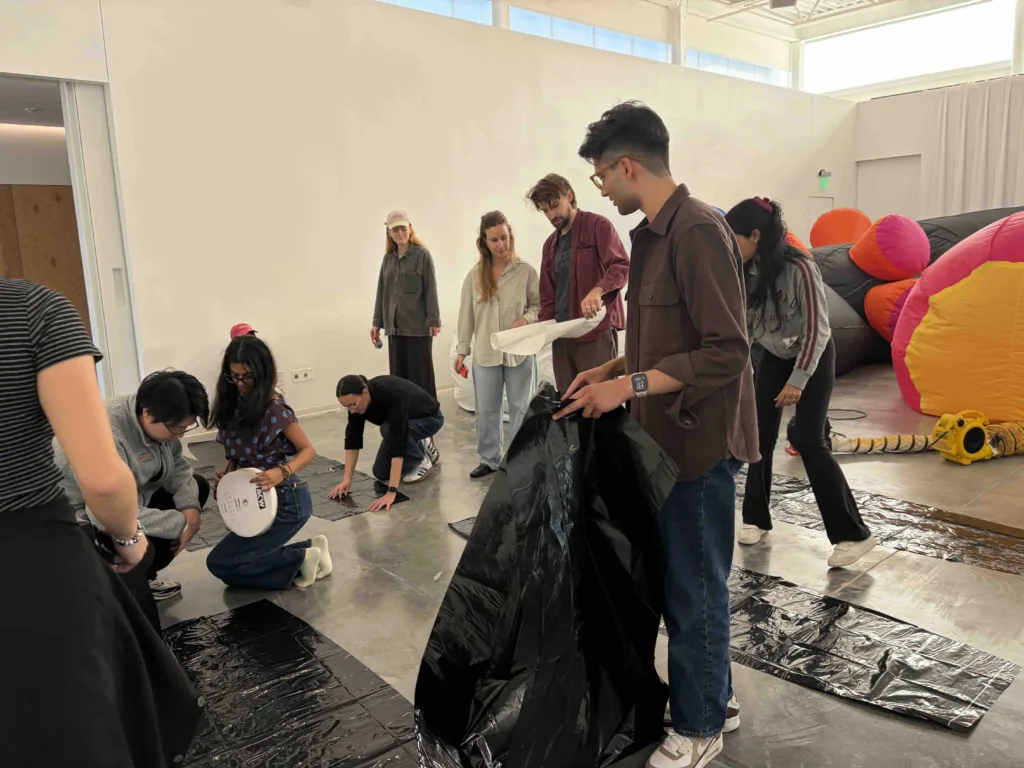
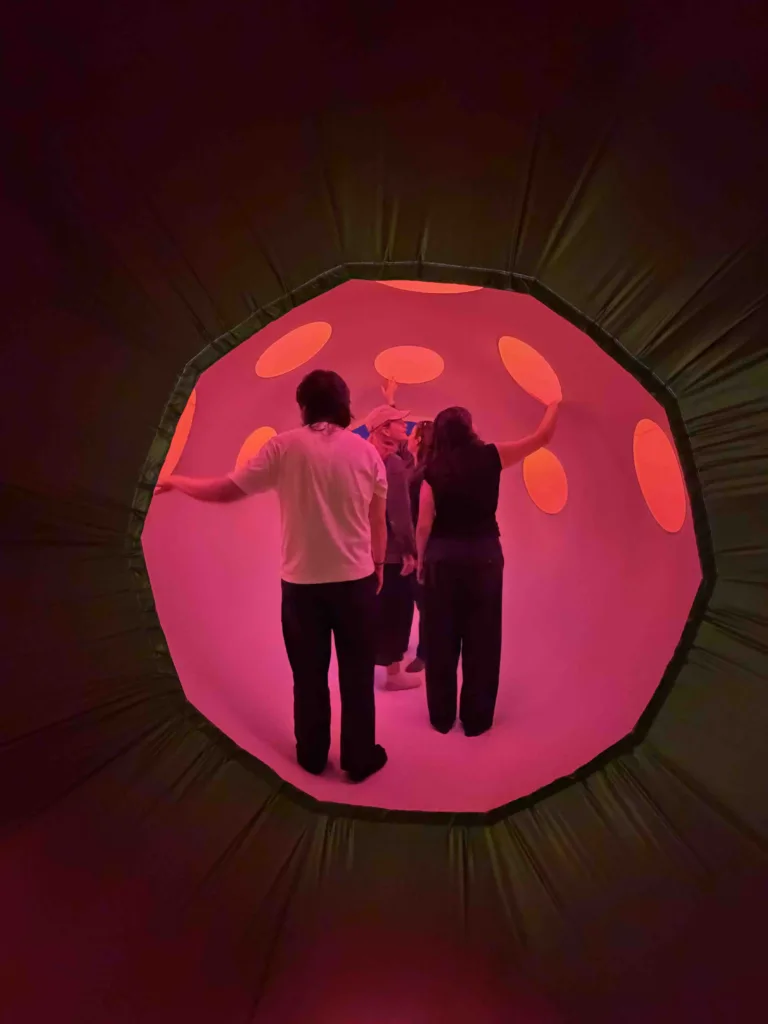
The Mylar crinkles and snaps as it fills with air, forming a ball about ten feet in diameter. Students work side by side to attach its opening with Velcro to the rest of the structure. From the exterior, the inflatable structure looks like a massive, multicolored caterpillar, with three clear cones on its head, and pink, orange, and blue protrusions along its body. Inside, students wave their hands into the cones, while those on the outside high-five them. At the other end of the room, the designer, August Lehrecke, cofounder of the design studio Pneuhaus, unzips a door to let students out. They emerge laughing and smiling.
“Inflatables are inherently playful,” says Lehrecke. “Kids immediately get it. And adults have a sense of comfort from the childhood quality of our projects.”
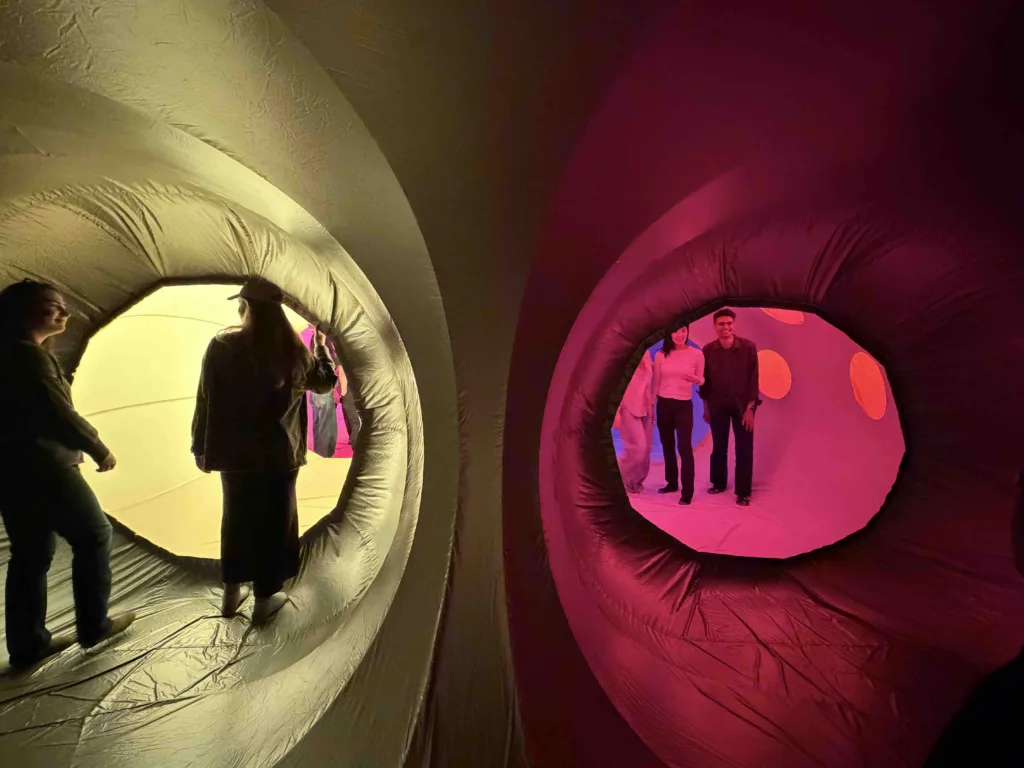
In a workshop hosted by the Harvard ArtLab, Lehrecke tasked a group of 24 students in the Master in Design Engineering (MDE) program, jointly run by the Harvard Graduate School of Design (GSD) and the John A. Paulson School of Engineering and Applied Sciences (SEAS), with creating two additions to a pneumatic prototype he had made. Students spent an hour carefully piecing together precut segments that Lehrecke had prepared, then attached them to the structure, inflating it with an electric air pump that runs continuously. The workshop preceded a lecture that Lehrecke gave at the GSD that evening and provided a playful, hands-on experience for students related to serious research on pneumatic architecture happening at the school.
Lehrecke cofounded Pneuhaus with Matthew Muller and Levi Bedall in 2014. As students at the Rhode Island School of Design, they were inspired by a course project; after graduating, they followed their curiosity and kept designing pneumatics, which Lehrecke describes as “experiences with fabric and air.” They started out living and working in a studio space in Providence, Rhode Island, and have since grown to a team of six who continue to design and fabricate everything themselves. Their projects range from public inflatable seating tubes to an anemone-inspired installation at the Shelburne Museum in Vermont to an open-air pavilion for an arts festival in Providence.
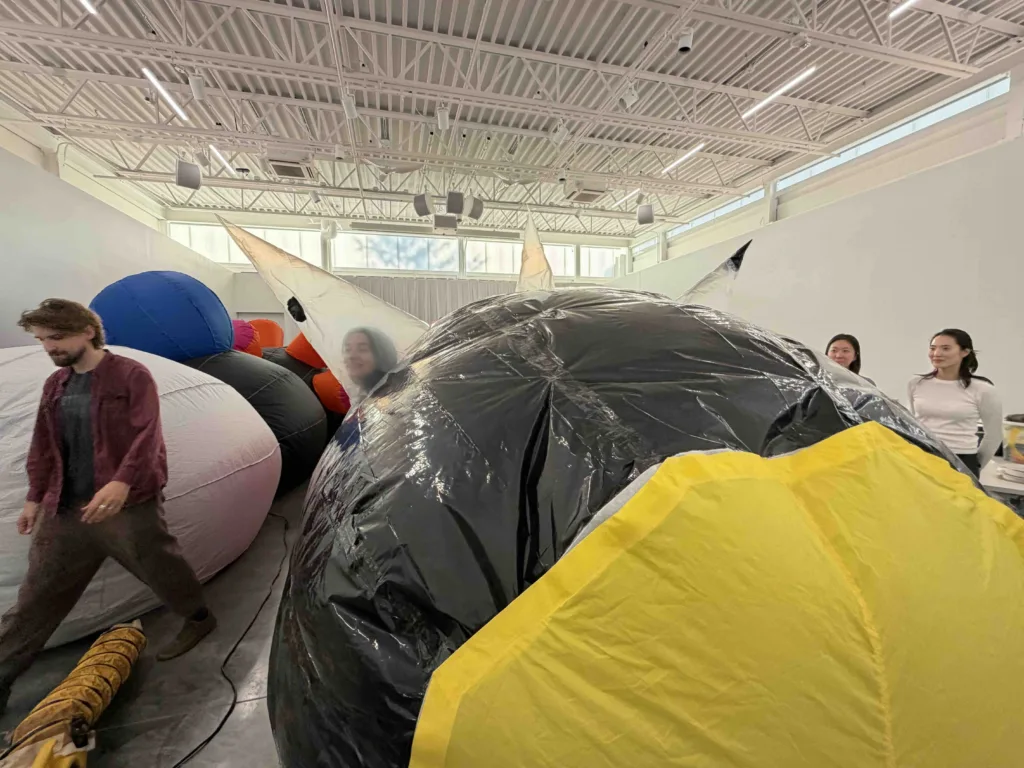
“We’re interested in all things fabric, light, air, and color,” he said as students pieced together their inflatables at the ArtLab. “We’re fabric nerds.”
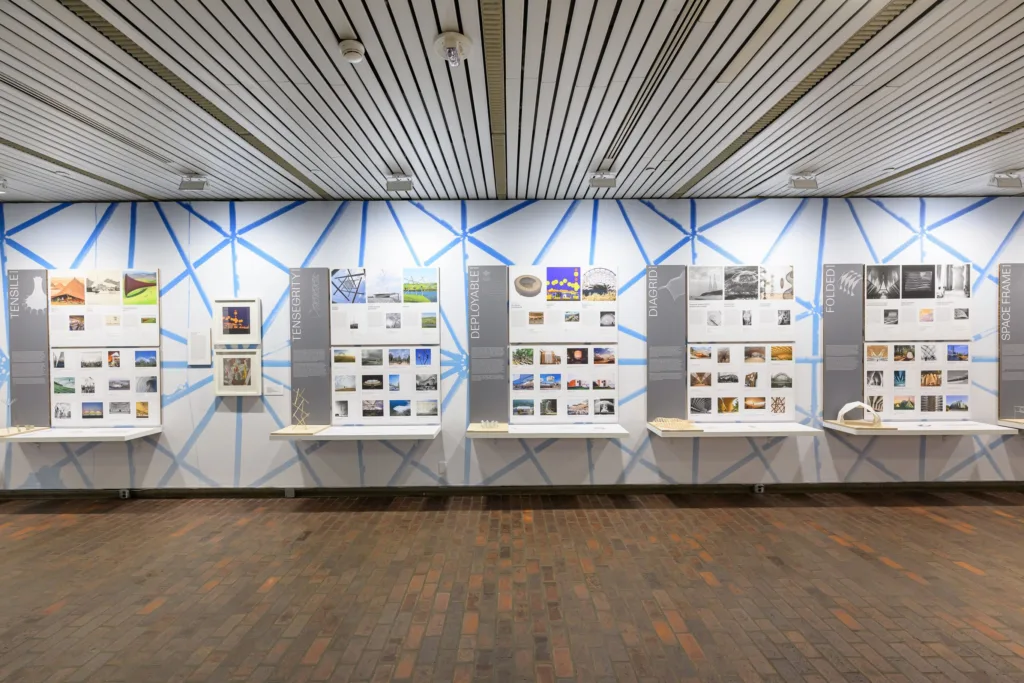
At his talk that evening, Lehrecke traced the history of pneumatics from antiquity to the space age—a history that he, Muller, and Bedall had explored early in their careers. It was an opportune time to delve into this history at the GSD: many of his examples were on view in the GSD’s Druker Design Gallery as part of Infrastructure in a Time of Flux: Methods, Conditions, and Situations. Organized by Rahul Mehrotra, John T. Dunlop Professor in Housing and Urbanization, and Dan Borelli, director of exhibitions, the exhibition traces a history of temporary architecture and urbanism that ranges from nomadic tent communities to contemporary pneumatic structures in China’s cities.
Lehrecke touched on sailmaking, which can be dated to around 4000 BCE; the first hot-air balloons, in 1783; and the rich era of experimentation with materials and forms in the 1960s and ’70s. The art and architecture collective Ant Farm, for example, made giant inflatable pillows that could be inhabited, and later published in Inflatocookbook (1971), a guide to building them. Graham Stevens created the floating pneumatic structure, Atmosfields (1970), on which he could jump and play, and developed Desert Cloud (1972), a solar-heated membrane designed to float above the desert and shade the earth.
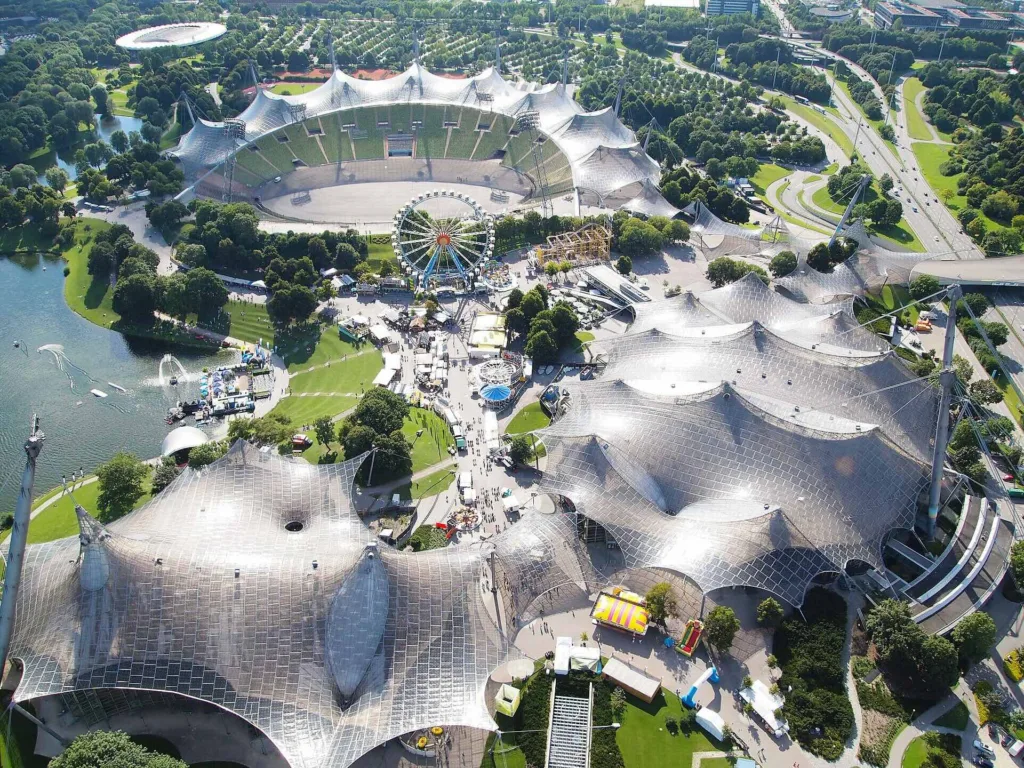
Haus-Rucker-Co designed inflatable “appendages,” as Lehrecke called them, for existing buildings. One, Oase Nr. 7, was a bubble big enough to hold plants and people that jutted out from the facade of the Fridericianum in Kassel, Germany, during Documenta 5 in 1972. They also built what may be one of the first attempts at a virtual-reality device, the Flyhead Helmet, with green inflated plastic through which one could look to experience a changed world. Lehrecke and his partners were fascinated by the works of Frei Otto, who founded a center for lightweight construction in Berlin in 1958 and the Institute for Lightweight Structures at the University of Stuttgart in 1964. Otto designed a range of tensile-membrane buildings, or tents, such as the roofs of the Munich Olympic Park, built for the 1972 Summer Olympics. The more fantastical Instant City, published in Archigram magazine in 1970, proposed a network of airships that carried a vast tent to different sites to create a “traveling metropolis.”
But pneumatic design stalled in the 1970s, Lehrecke explained, when the oil crisis made plastics more costly to produce. It wasn’t until more recent advances in fabric technology that pneumatics took hold again. High-tech membranes now go on space missions and clad permanent buildings, such as the Kendall Square Garage Screens in Cambridge, Massachusetts, by French 2D, the firm of Jenny French, associate professor in practice of architecture. The National Stadium in Beijing, designed by Herzog & de Meuron, incorporates both ethylene tetrafluoroethylene (ETFE) and polytetrafluoroethylene (PTFE), materials that have become popular for weatherproofing and soundproofing.
Lehrecke noted during the workshop that he and his team are interested in knitting and how it might create stable structures, a line of inquiry that researchers at SEAS are also pursuing. Lehrecke collaborated directly with faculty and students at the GSD who are asking similar questions about multistable fabrics (which hold multiple forms) and inflatables. Martin Bechthold, Kumagai Professor of Architectural Technology, and Hye Jun Youn (MDes ’23) worked with a team at SEAS to find a way to use thermoplastic polyurethane film to create multistable shapes when inflated. Building on the crumples that occur naturally when the films are inflated, Bechthold and Youn found that these forms can be reshaped into different stable configurations, rather than only the two states, inflated and deflated, that pneumatics typically take.
Youn began experimenting with inflatables as a student at the GSD, making what she calls “Pneu-bots,” robots that incorporate pneumatic devices. Bechthold became her advisor at the GSD, and together they collaborated with Katia Bertoldi, William and Ami Kuan Danoff Professor of Applied Mechanics in SEAS, and the three published their findings, “Reconfigurable Inflatables,” in the journal Advanced Science. Youn also collaborated with Leon Kamp, a graduate student in Bertoldi’s lab who had experimented with multistable structures inspired by origami.
As fabric technology and construction continue to advance, pneumatics are proving to be more than playful interventions. Though most are made from petrochemicals, they may hold answers to the climate challenges ahead. For example, designers such as Andrzej Cahlenstein are circling back to the innovations of the 1960s and ’70s with new materials and applications; Cahlenstein’s The Veil is inspired by Buckminster Fuller’s 1959 Manhattan dome, and proposes using graphene to cover Siberia in 2050, when melting permafrost is expected to release the greenhouse gas methane.
There are not yet natural fabrics suitable for pneumatics, Lehrecke noted in his lecture, but there may be in the future. He explained that Pneuhaus’s clients help push the company into new territory by providing constraints for projects. Among other projects, they have created a prototype of a bivouac tent for divers doing multiday dives and collaborated with NASA to create an inflatable exhibit space for robots.
“Working with clients brings us to different places,” he says. “When you’re not in control of what you make, it’s a fun exercise in figuring something out.”