Living Well in an Uncertain World
The curators of “A Temporary Exhibition of Temporal Public Spaces” discuss emerging design practices in Taiwan, Hong Kong, Thailand, and Korea
A cone of intersecting strips of red-white-and-blue woven vinyl fabric greets visitors near the entrance to A Temporary Exhibition of Temporal Public Spaces, on view at the Harvard Graduate School of Design’s Frances Loeb Library through May 17. In the Asia-Pacific region, the versatile material is used for bulk carrier bags or the tarp roofs of market stands. Su Chang Design Research Office reimagined the sheeting as a shade parasol, drawing on the vernacular structures seen in Hong Kong’s fishing villages. Combined with folding stools in matching material, the parasol satisfies what might be called the minimum viable conditions for a nice place to sit in a subtropical climate.
Curators Yun Fu, design critic in urban planning and design, and Yona Chung, a doctoral candidate, both at the GSD, gathered the work of emerging practices in Hong Kong, Taiwan, Thailand, and South Korea. The exhibition celebrates what Fu calls “cheap and cheerful” responses to a need for vibrant public space, even if the architectural conditions that define those spaces exist only briefly.
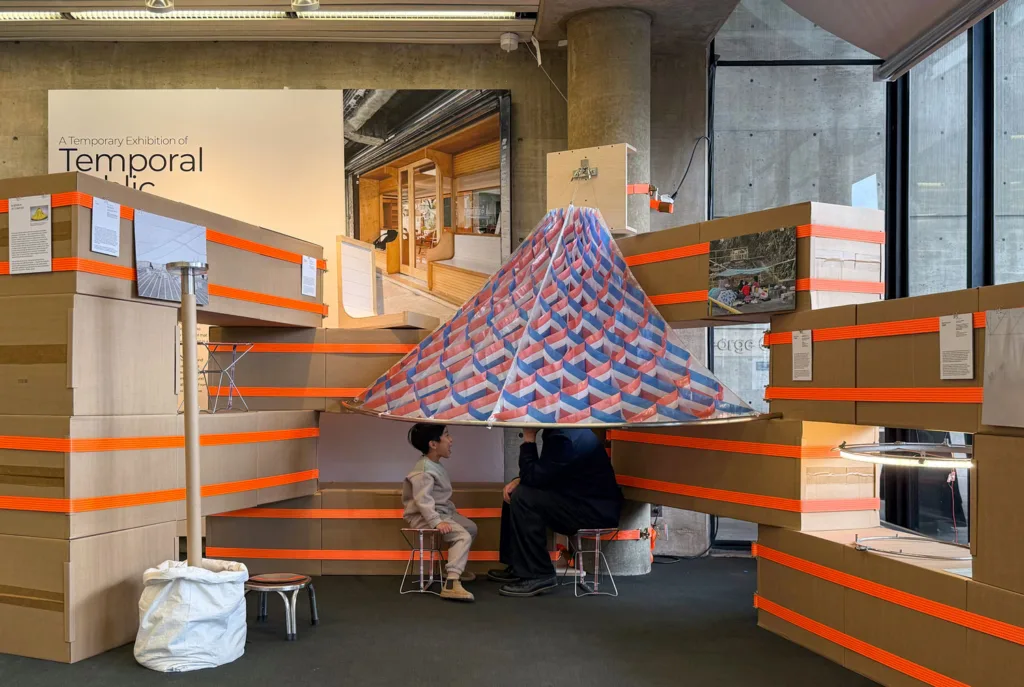
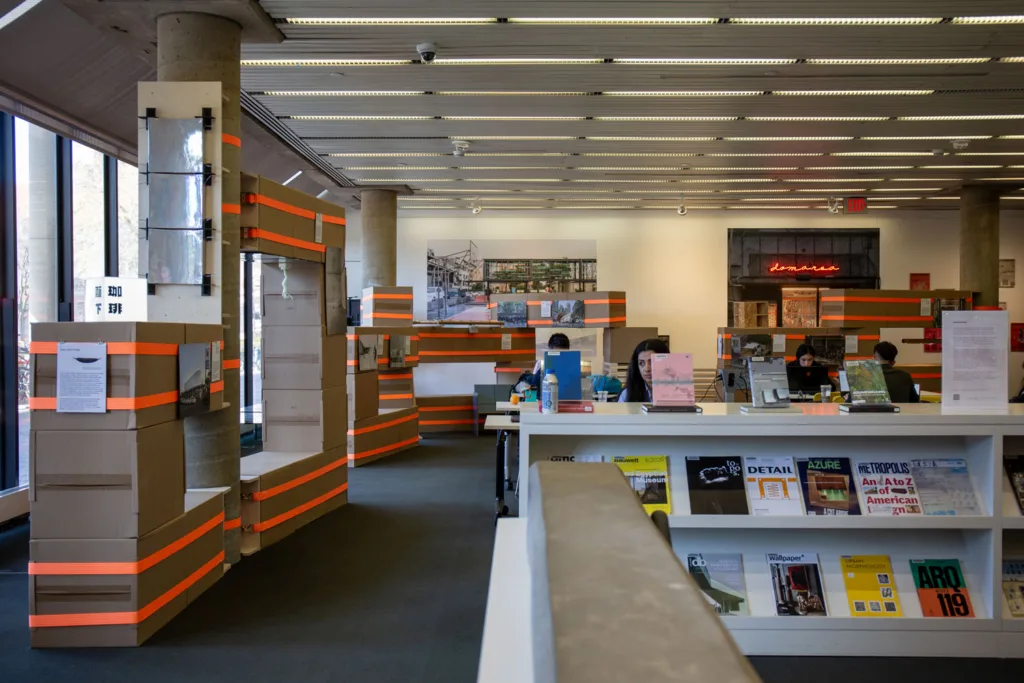
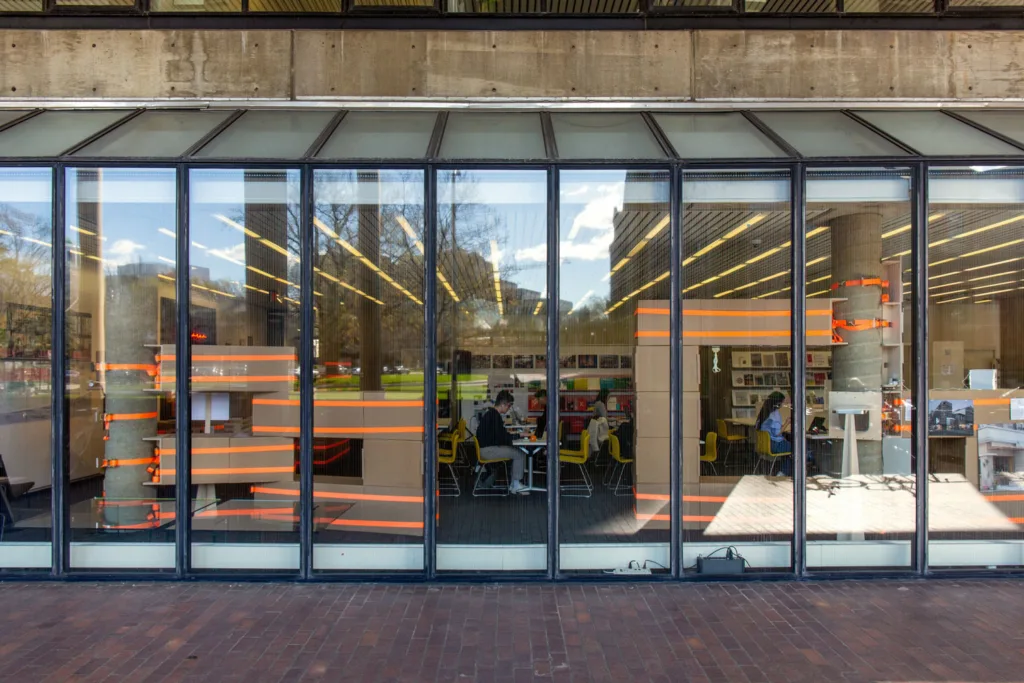
Noting the inadequacy of traditional architectural drawings to capture the essence of such work, Fu and Chung chose to represent each project not only with photographs and descriptive texts, but also with actual artifacts. These evocative fragments from the real-world projects range from neon lights to wood supports to exterior tiles—all small in scale, more-or-less capable of fitting into a piece of checked luggage. The exhibition architecture, designed in collaboration with GSD students Peihao Jin, Runkai Jin, Zheng Cao, and Zili He, comprises a series of alcoves defined by uniform cardboard boxes that have been joined together by bright orange ratchet straps. Like the projects themselves, the display appears as if it could be packed up and shipped out on a moment’s notice.
The temporary space is presented as a starting point for new design work, but also as a response to conditions in the Asia-Pacific region, and more specifically the political-geographic configuration known as the Milk Tea Alliance. Originating in internet memes, the term captures both a shared fondness for sugary, boba-infused beverages and a common feeling of uncertainty about political change, economic disruption, and cultural identity. Fu and Chung spoke with William Smith, editorial director at the GSD, about the exhibition, the history of urbanism, and the best way to order milk tea.
William Smith
The projects featured in this exhibition re-imagine public spaces in sophisticated ways. You also identify them as “starter” projects from emerging firms. What’s the connection between temporary spaces and early-career design?
Yun Fu
There is a pathway to professional practice common in our teachers’ generation. The pathway is: you graduate, you work for somebody, you get your license. And if you’re good and responsible, then your parents or your family friend would commission a house. And that would be your start. You do a small house, you do a big house, you do a small school, you do a big school, you do a small museum, and then, for your magnum opus, you do the big museum. Then you retire. That’s a great career.
A temporary pavilion at a museum or biennial could be a part of this pathway, at least as a stepping-stone. But the aspiration always has been to test out ideas through temporary pavilions in order to implement them in a permanent project.
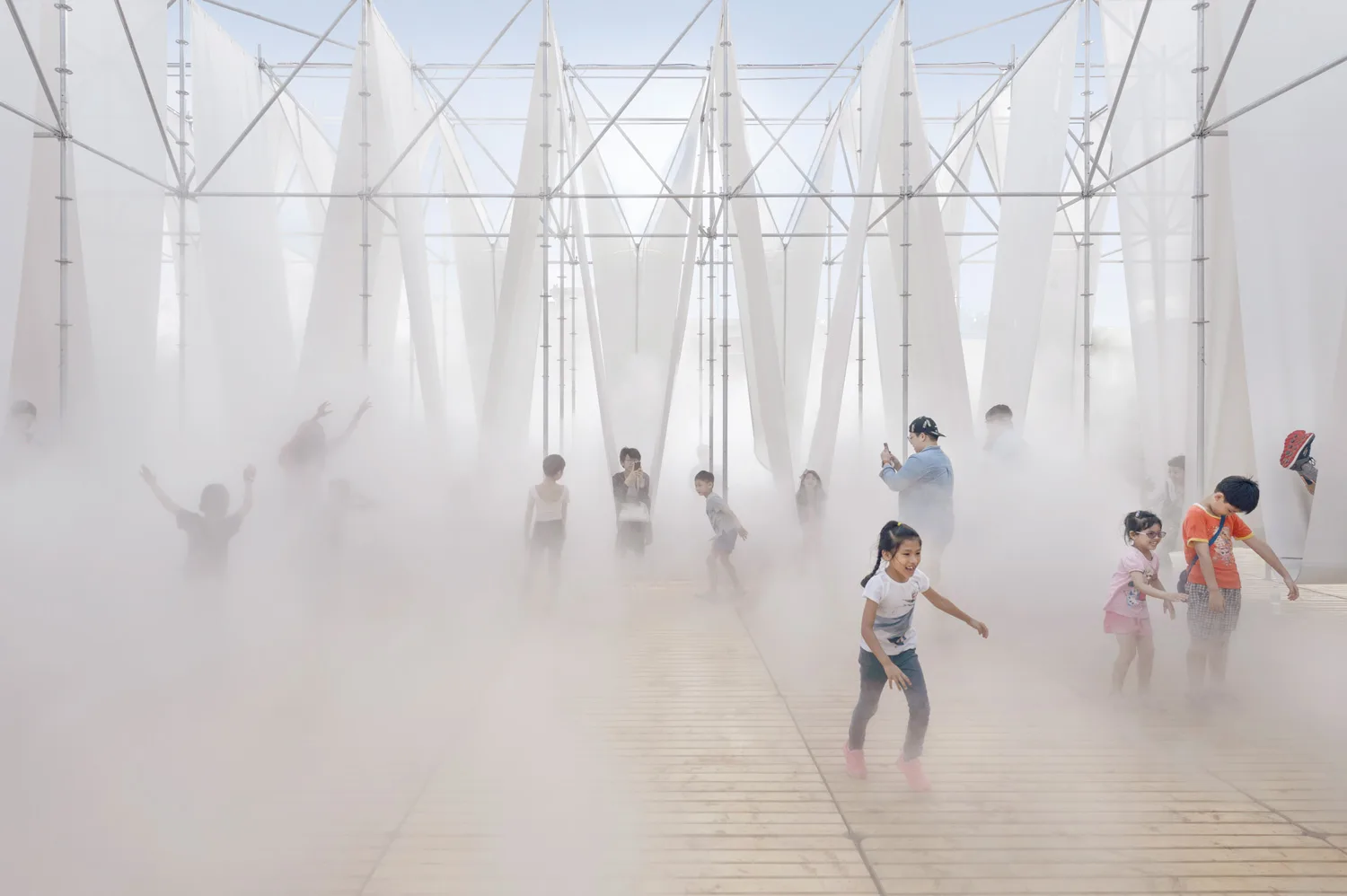
There is now a different path among our colleagues—their starter projects are often temporary, temporal projects. Serendipity Studio, Shen Ting Tseng architects, and Bangkok Tokyo Architecture, for instance, were founded around temporary public space commissions. A very good body of work has accumulated over the last decade that we thought was under-explored, but also an emerging worldview. The way the practitioners in the show were thinking about these temporary public space projects was no longer so much about using them as a stepping-stone; it is the work in and of itself.
William
Why do you think this sensibility has emerged specifically in the regions that you survey in the exhibition?
Yun
This particular generation of designers in this particular part of the world is facing an acute condition of uncertainty. It’s not as if there’s no money or no projects around, but the clients and the government don’t really know if they need a project for three months or 30 years. They’re still willing to commission a project. But it comes with amplified degrees of uncertainty that forces designers to work in certain ways. The projects in the exhibition are responding to this pervasive condition: they’re prototyping a cohesive approach to living well amidst uncertainty.
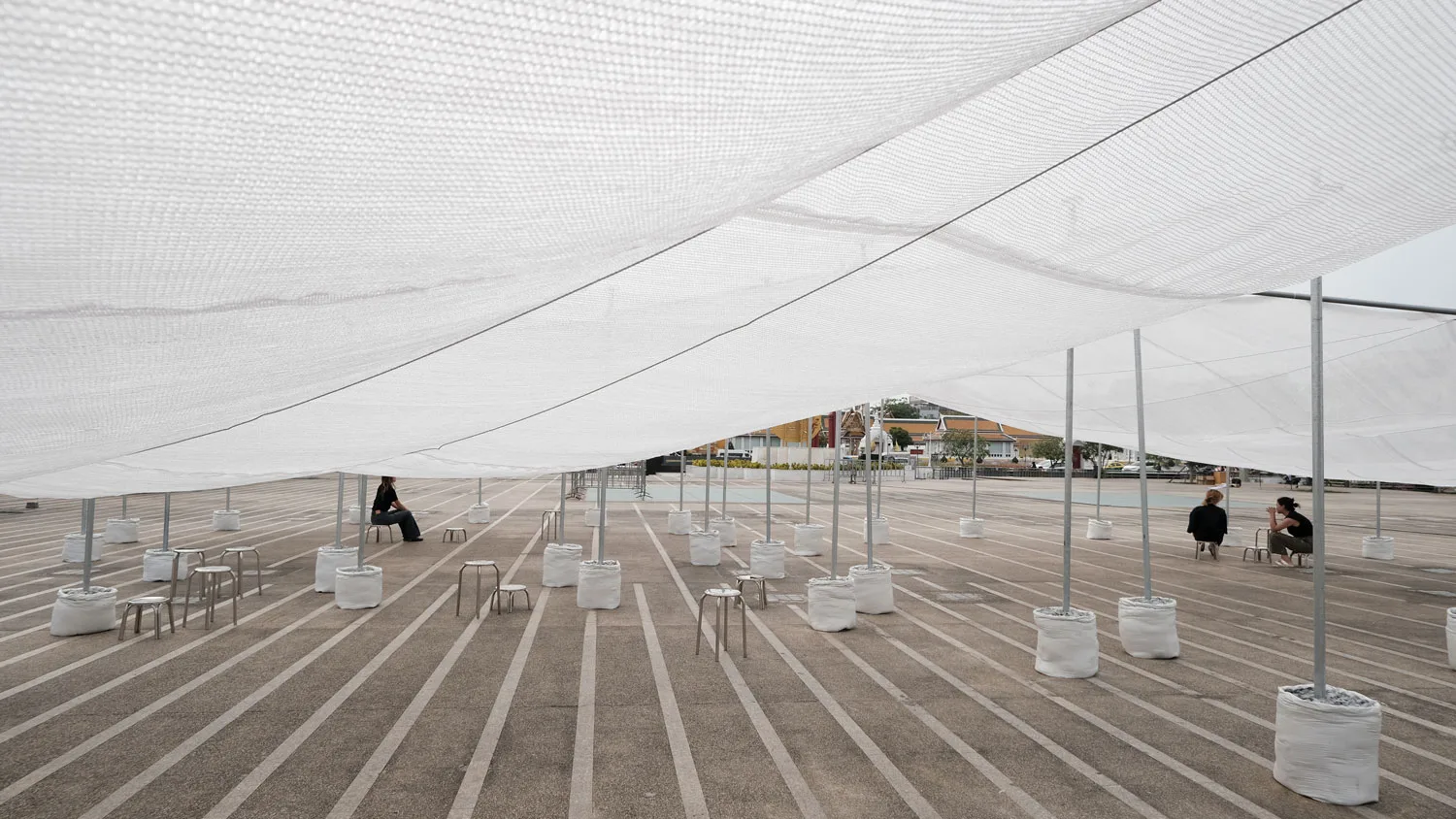
There is the familiar notion of national development: you need to get wealthy, you need to become politically stable, ideally democratic. And then you can talk about the good stuff, providing citizens with a high quality of life. That’s the Switzerland model. But not everywhere in the world can become Switzerland. And you find that in places like Thailand, Taiwan, Hong Kong, and Korea—these places have found a way to deliver a distinct and high quality of everyday life without waiting for the supposed prerequisites to fall into place. As other regions face similar challenges of uncertainty and scarcity—even in advanced contexts once thought to have graduated from these challenges—the experience offers shareable lessons.
William
How does this idea of a good life find expression in temporary public spaces?
Yona Chung
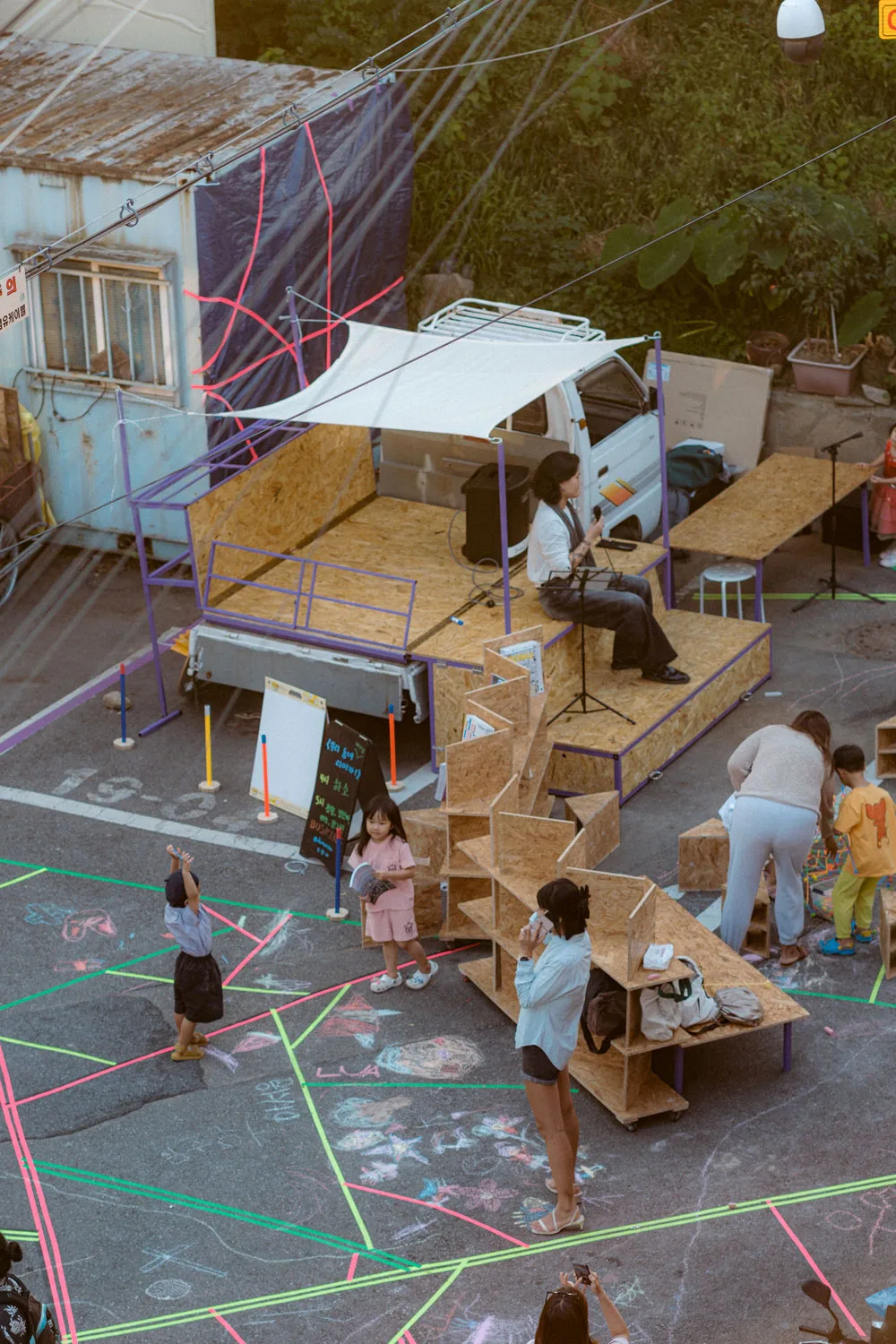
It’s very hard for the built environment to respond immediately to people’s needs, because it tends to lag the speed at which lifestyles evolve particularly in modern Asia, so designers are turning to faster, if temporary solutions. One of the Korean contributors in the exhibition, PRAUD/domansa, has a mobile project called Urbi-Box—a small truck with a kind of pop-up pavilion in the back. It makes reference to the “rear car,” a mobile amusement with rides for kids, that was once part of Korean street life. Historically, there would also be a guy with a cart full of makgeolli, a traditional alcohol. That’s how the public spaces were created—that’s how the publicness was achieved. It’s a very small device, but it’s convenient, addresses people’s needs, and makes everyone happy. An immediate response to the needs of people doesn’t need to be something big or something that lasts long—it can be lighter and more readily available. There’s a certain beauty to that.
Yun
Many of the projects in the exhibition are like that—they cannot be represented by normal architectural mediums of plan, section, elevation, and models. It’s about design that occupies space only at certain times of day and it disappears. OH DEAR Studio in Tainan has a music venue, for example, that exists only when people gather at the time announced on social media, and returns to anonymity when the set ends. Su Chang also has an evolving series of parasol structures drawing on vernacular inspirations to provide shade for events and gatherings as needed. That’s why we try to use an object to convey the sense of the project. These small fragments can germinate at least the imagination of a larger whole.
William
Some of these public spaces may exist for fleeting moments, but they also express a strong historical consciousness. How can temporary public spaces recover earlier patterns of urban life?
Yona
domansa talk about designing for street life rather than a specific morphology of the built environment. They looked back at a time in urban Korea characterized by the intimacy and closeness of collective living. There’s a saying in Korea that people in Korea want to know how many chopsticks and spoons their next-door neighbors own. This sensibility was lost during the rapid industrialization of the 1970s through ’90s. Apartment living became the norm, and gated complexes were suddenly everywhere.
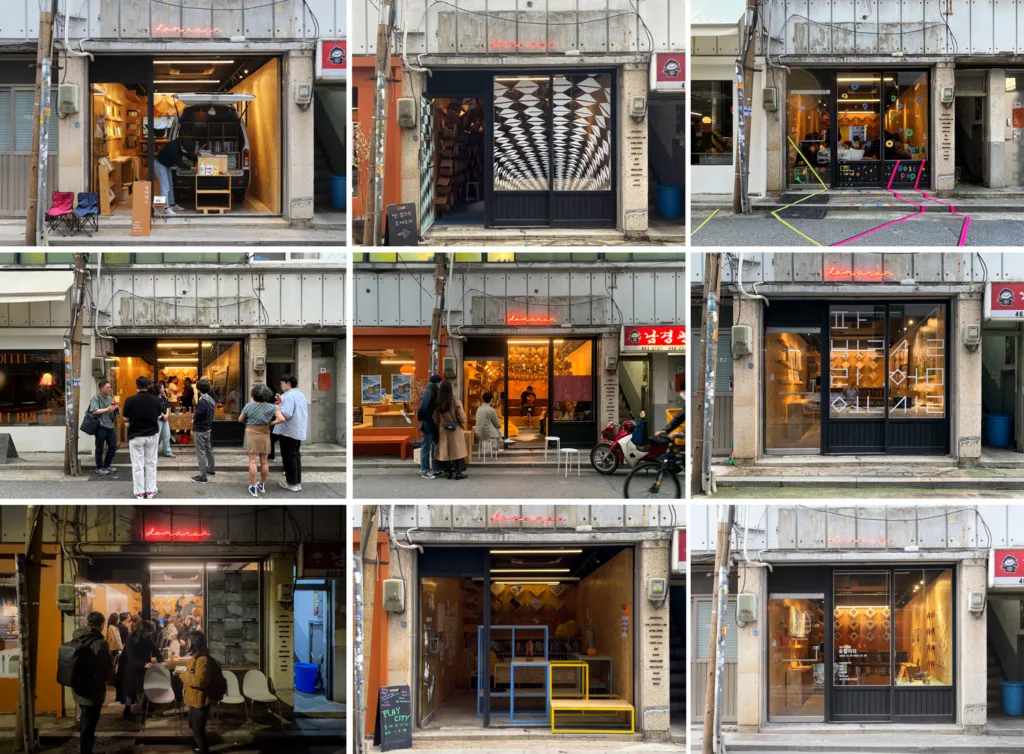
domansa wants to use design to restore a collective way of living. Design is not a final outcome, but a medium to bring people together. That’s their way of referring back to the past, preserving the sensibility of collective living even though it may look very different today.
William
Some of the projects were commissioned by cultural institutions. Others exist in cafes or commercial spaces like markets and even gas stations. Do you see a tension between these contexts?
Yun
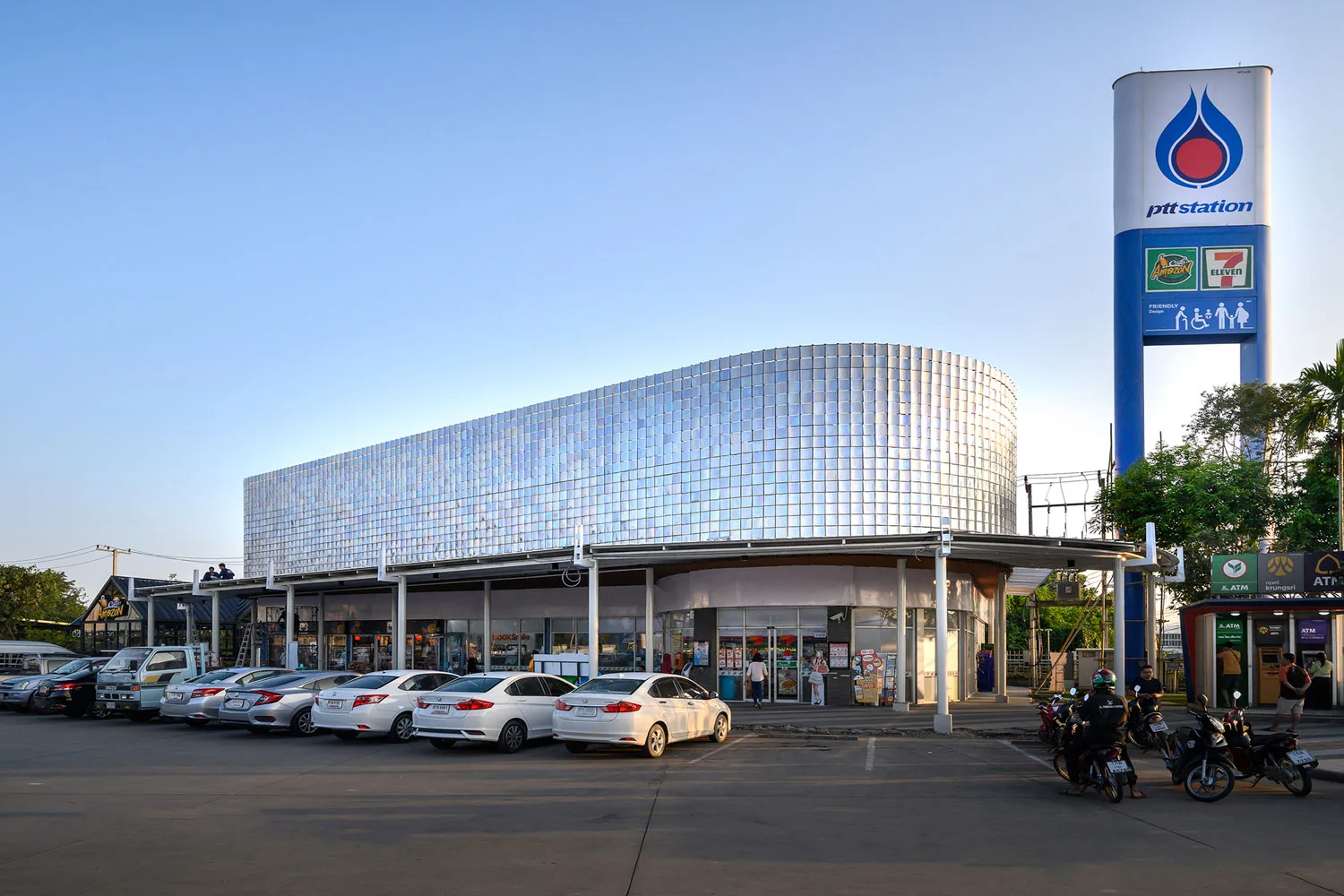
There’s already a well-documented literature about how the notion of high-brow versus low-brow spaces, commercial versus public, is not a particularly useful binary for understanding the Asia Pacific region. On the ground, the distinction is not so clear.
In Asian cities, there’s no such thing as the plaza as it’s understood in a Western context. The closest cousin is probably the square in front of the imperial palace, where you can knock on the gong and appeal to the emperor if you feel that you were unjustly treated. And then you have the tea house and the market—which are overtly commercial even though they were also the default public spaces.
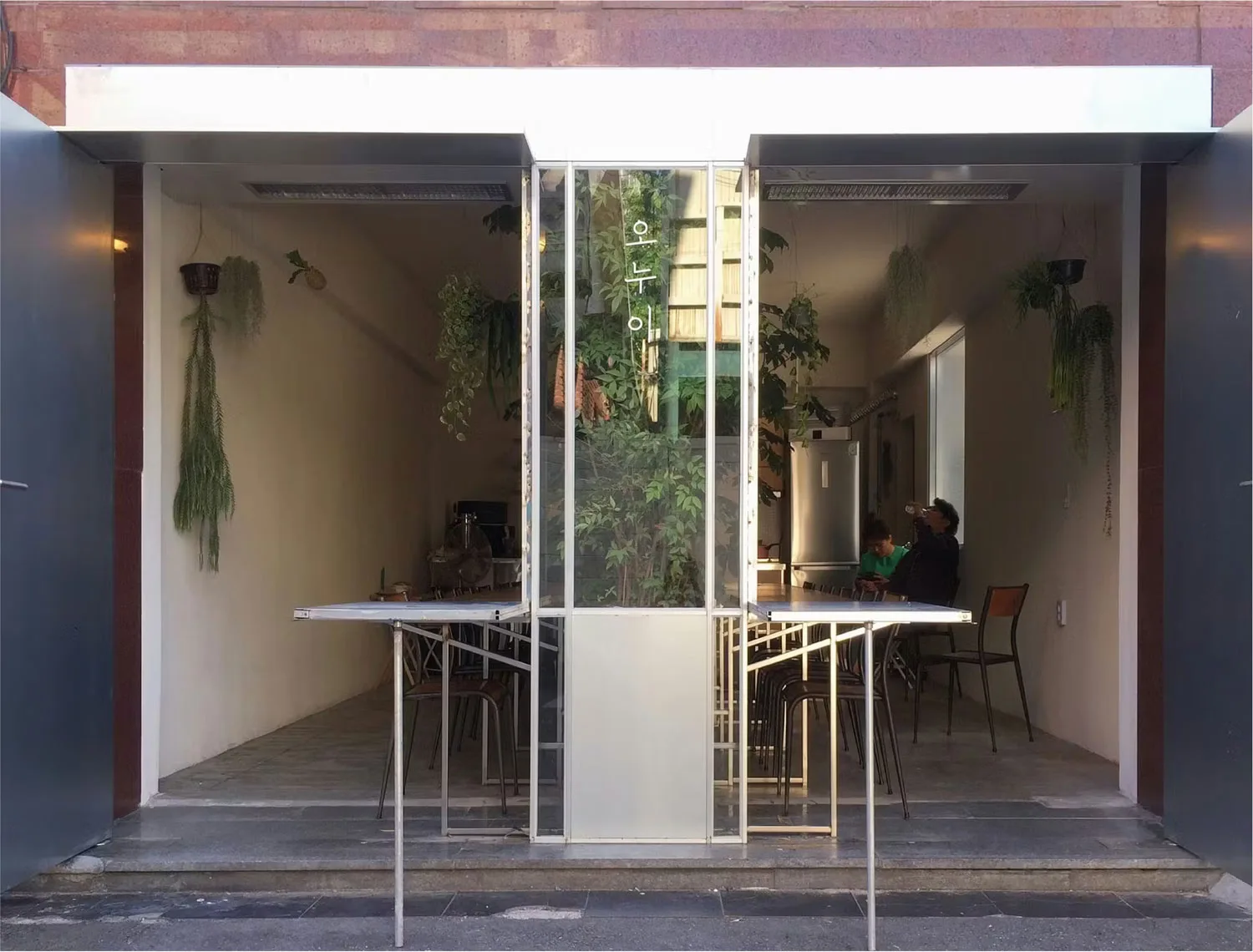
A lot of projects that we feature, including FHHH friends’ neighborhood cafe in Seoul and Sher Maker’s Gas Station at the entrance to Chiang Mai, are commercial projects, but I think they are public in a way that is native to their part of the world.
Yona
In Asia in particular, consumption is more embedded in everyday life than it is in the United States. It’s very convenient for people to occupy space by purchasing something. For instance, coffee culture: cafes in South Korea have become like secondary living rooms. It’s not just coffee you’re consuming. You get to sit in a space, and that space you can own for two hours. Consumption becomes a way of occupancy.
Consumption is also tied with the experience of space and time. A lot of pop-up stores in Korea, for instance, are trying to make the time that people spend in certain spaces as experiential as possible. It’s not just the product they’re consuming, but the whole atmosphere—the route you take from the subway station to a certain fashion store. Like how that street is aligned with other stores and spectacles.
William
How does urban density drive that kind of experience of space?
Yona
There’s a notion in Korea called bang that’s so familiar it is often overlooked. It means basically a room. People don’t realize how great an invention it is. The bang culture gives rise to societal acceptance of accumulating different programs within one building. In a five-story building there’s a karaoke room in the basement, a Korean barbecue place on the first floor, a photography room on the second, and so on. It’s stacked by these different programs, with the Korean concept of “room” defined by that programmatic mix. If you are given a space, even a small space that people can occupy, whatever you do inside doesn’t matter. It’s a notion of acceptance.
Because Korea’s housing market is really standardized, it’s normal for people to hang out outside home. Bang became a third space for people to socialize and find their own identity outside the family.
William
I was struck by how many firms in the exhibition are working outside of cities. How do rural approaches to public space differ from those in cities?
Yun
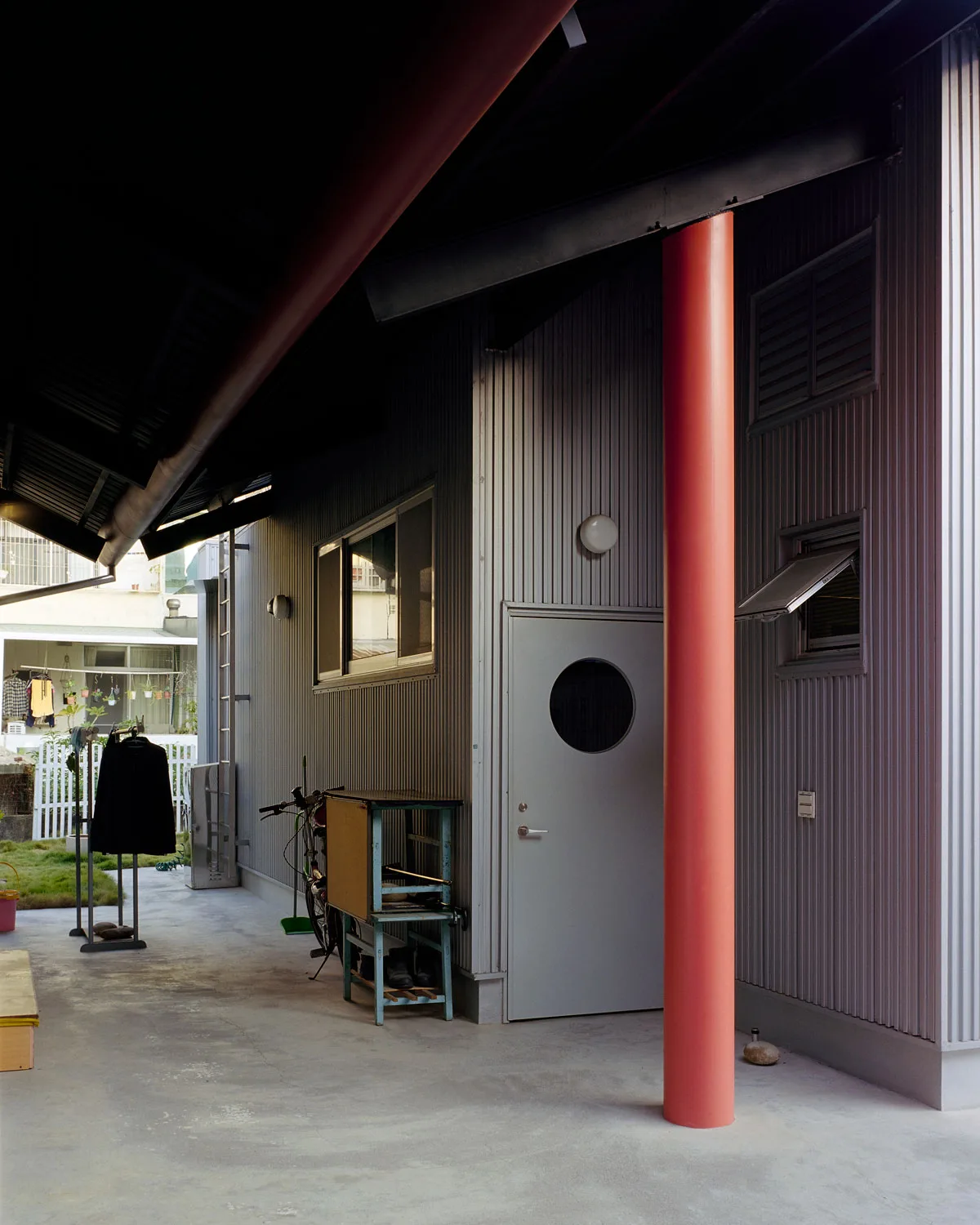
The town and country, urban/rural binary is also not cut in the same way in Asia. Anthropologists studying Indonesia in the 1960s and ’70s developed the notion of the desakota region, which basically means city-country. In the modern Western notion, you have the city, and then you have everything outside it. In much of Asia, however, there is an in-between zone of everything. There is a motorcycle repair shop next to a rice paddy next to a three-story apartment building. It’s a continuous territory. One of the studios in the exhibition is Studio Tngtetshiu (長短樹鄉村研究所), literally translated as something like the Tall and Short Tree Village Research Group. The village where they are based and study closely is only a 30-minute moped ride from the center of Tainan city. Likewise, the Thai studio Sher Maker is based around Chiang Mai, and draws on a craft culture unique to a region and not easily found in city centers.
William
We’ve been talking about practices in Hong Kong, Taiwan, Thailand and South Korea. Do these places comprise a region? How do you define that, and why not just look at the Asia-Pacific overall?
Yun
It’s a survey problem. We have a region and we have a limited number of locations we can sample. What kind of sampling strategy would give us an insightful view? Do we look at the center? Do we overlay a grid and sample every module? Or do we look at the edges? We are primarily interested in the edge conditions because the center is pretty well understood–places like Japan and China already have well- established discourse and institutional support. We were more interested in the places around them, because it’s often at the periphery where the uncertainty is sharpest, and where shifts and changes are registered first. But it’s also that these places share something–a resourcefulness in response to uncertainty–that we think constitutes a coherent, if under-recognized, design culture.
William
What kinds of shifts are you seeing?
Yun
In places like Western Europe, North America, and South America, many of the most interesting young designers cluster together and all know each other pretty well. There’s camaraderie, and ideas are exchanged. That’s surprisingly less true in the Asia Pacific.
Conversations about design have been constrained in the last 50 years by notions of the nation state. Postcolonial questions about what is or isn’t a country have produced, in reaction, a very strong protection of national identity. The default is for each country’s resources, including funds, to only support their own designers. Part of what made this exhibition possible was a particularly open-minded group of supporters willing to think beyond national lines–Taipei Cultural Center of TECO in New York, Harvard Asia Center’s Southeast Asia Initiative and Thai Studies Program, the Design Trust in Hong Kong, among others, who recognized the necessity of supporting a cross-regional project. One of the initial challenges is how we might give this region a cohesive shape that’s not defined by familiar designations of ASEAN, the four Asian Tigers, or the Sinosphere.
William
How does the “Milk Tea Alliance” help us understand the work in the exhibition?
Yun
There are different ways of defining this region, and they have their own limitations and strengths. For our purposes, the notion of the Milk Tea Alliance was useful. This is not an academic term but comes from an online meme. Starting in 2020 in Thailand, Taiwan, Hong Kong, and more recently in Korea, there was a renegotiation of the social contract, with protest movements raising questions about democracy and the meaning of citizenship.
Netizens noticed that people in these places happened to like milk tea. They called it the Milk Tea Alliance. The alliance was about a sense of camaraderie. You could empathize with people in other contexts because you were dealing with similar challenges, or you were working towards a similar kind of society. We’re still digesting this term, but it really is more than the internet being silly.
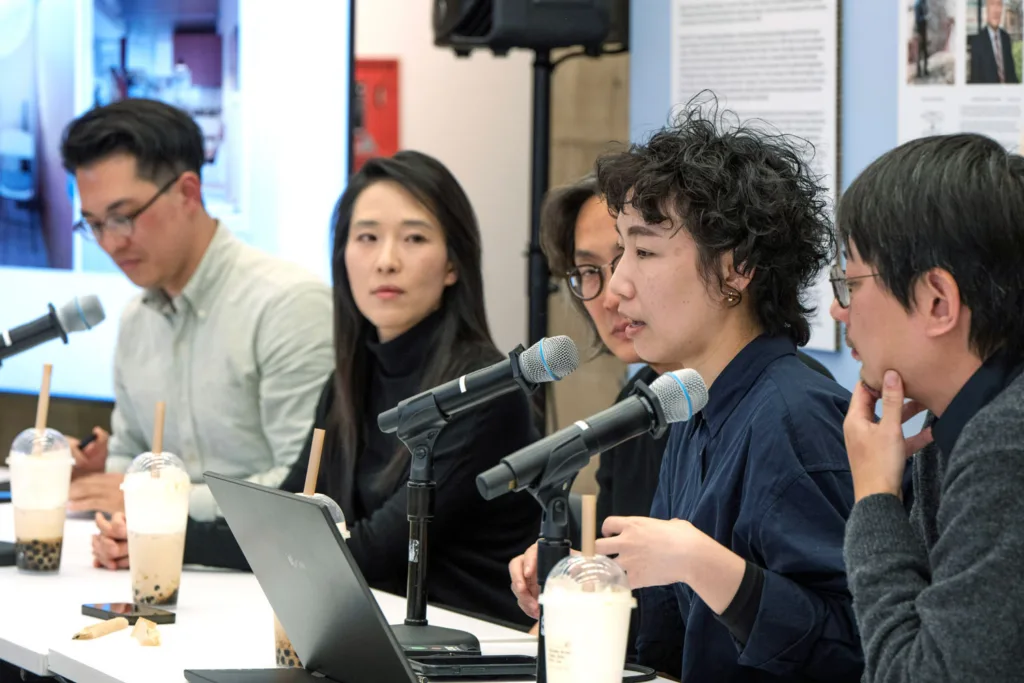
Think about the ingredients in milk tea. The tea comes from India and China. The practice of adding milk comes via European trading routes. You already need a certain East-West, cross-cultural background for milk tea to be available. And a culture of milk tea requires an irreverent attitude. It’s not like a British relationship to tea, where we always have to put the milk in first and stir it clockwise. In the Asia-Pacific we use the milk that the Europeans brought, but in our own way. And then maybe add some tapioca, or some coconut. There’s a sense of freedom and willingness to experiment and mix up inherited influences.
The Milk Tea Alliance speaks to the essence of something that we think is relevant in the cultures that we’re dealing with. Milk tea is also about addressing the immediate needs of people because it is infinitely customizable. You can choose your own sugar level. You can choose your own ice level. Do you want boba or not?
We ordered milk tea for our panelists at the exhibition symposiums, with their specific customizations—it’s a format we hope to continue.
William
How did the movements for democracy inform your thinking about design for public space?
Yun
During the shirt movements in Thailand, everyone had the same colored shirt, and many brought little stools to the protests. That’s the public space design, and people’s agreement that this is a special moment for them and for the country. We were also thinking about the brick arch in Hong Kong during the 2019 movements. People there used familiar bricks, placing one horizontally atop two vertical ones. It allowed them to sit and rest. They could stand on it to get a better vantage. But it also meant that it was more difficult for heavy vehicles to intervene in certain areas. We can also think of similar examples in Taiwan around the Sunflower movements of 2014.
This use of familiar, small elements to create larger cumulative effects evoked historical tropes. It gives power to the individual, and the social understanding between them, counter-balancing larger, top-down gestures.
Yona
In the recent democratic movement in Korea, a lot of young people in their 20s were protesting in front of the Gyeongbokgung Palace. And many of them were holding these light sticks associated with K-pop groups. Each fandom has its own light stick with a distinctive design and color—BTS is purple, for example. Those light sticks are expensive and are very precious items for the fans. They brought them to the street, and that was their way of protesting and crying out for democracy.
William
How did you make selections for the exhibition?
Yun
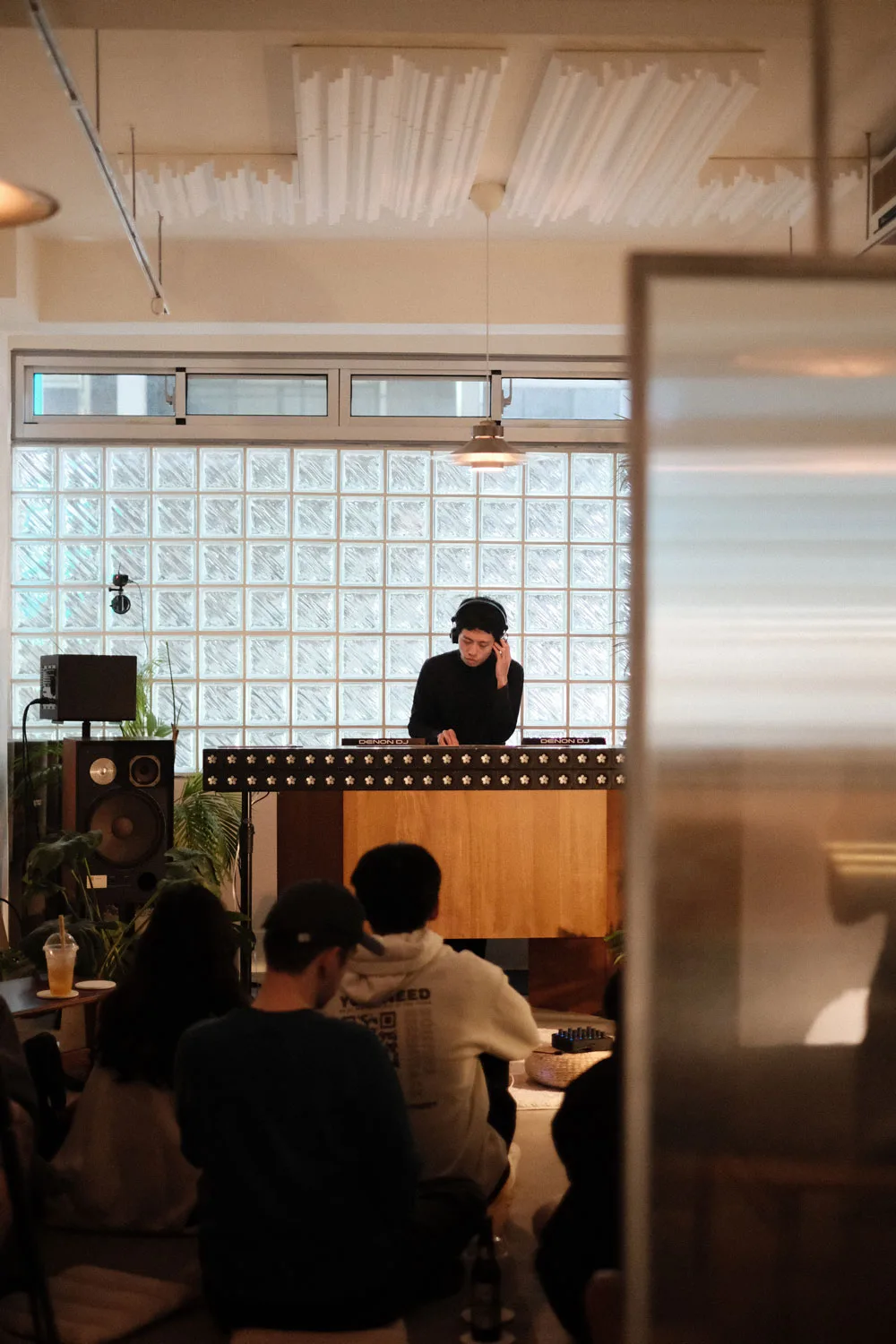
As we worked on the exhibition, we thought about who we could bring together to give a balanced picture of the scene. There are some architecture firms that would be recognizable as such anywhere in the world, but then others, like HYPERSPANDREL in Seoul and OH DEAR Studio in Tainan, remind us more of a movie production company. It’s hard to describe precisely what they do, but they do whatever it takes to get the project done. Most of them have architecture training so they can do architecture if you need, they can do interior if you need, but they can also help you to start a small business; they can help pick a coffee bean if that’s what you want. They can do graphic design; they can even help you source some funding or look for a place.
The natural next step would be to explore the kinds of production companies that take on design projects for commercial events and political campaigns, creating the jackets and the flags for rallies, hosting pop-ups, and sourcing accessories for fandom cultures in Korea. Some of the studios in our exhibition, like Atelier Let’s in Kaohsiung and SkilLABility in Tainan and Taichung are already moving into these adjacent fields naturally.
The notion of modern architecture in Asia is very new, existing for barely a hundred years—arriving via Japan, who took their definitions from the Germans and British. Today, architects have licenses and follow contracts. But an earlier building culture still exists, and these production companies embody it. It’s closer to people’s daily lives. You have a person who is part of a group who gets it done, whatever it is: renovate a shop, create a sign, get some firecrackers for opening day. Is it architecture? Part of it is.
William
How did you approach exhibition design, essentially creating your own temporary public space in the GSD’s Frances Loeb Library?
Yun
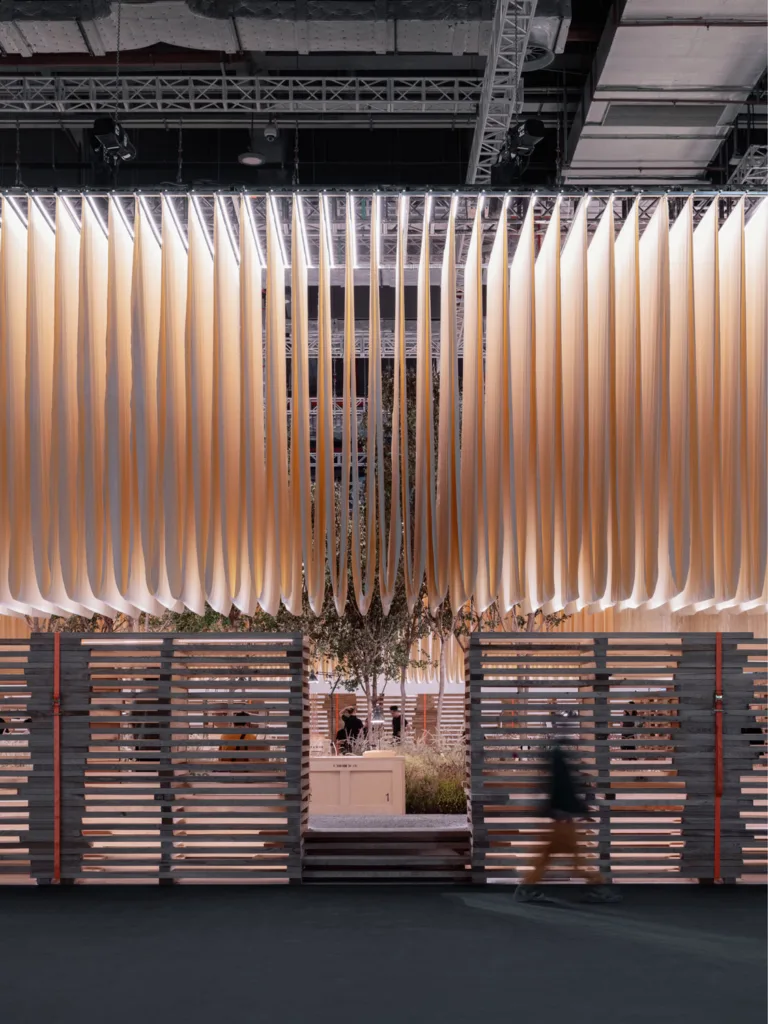
It is always a challenge to exhibit in the GSD library because you have to work around the very real constraint of the library remaining open and usable to students. The exhibition architecture speaks to the spirit of the projects that we’re featuring—often there are rigid constraints in the brief, and the projects offer a cheap and cheerful design response. We thought, we’re showing these temporary public spaces: wouldn’t it be interesting, in a medium-is-the-message way, if the whole exhibition itself was also a temporary public space? One of the studios in the exhibition, SEMESTER, has been returning 85 to 98 percent of materials to manufacturers after temporary installations—so the idea of an exhibition that could be packed up, shipped onward, and given away felt like a natural extension
We always knew it was going to be challenging to bring over the objects we wanted to show. In Asia, there are many domestic workers who come from the Philippines, Indonesia, Vietnam, Thailand, among others. Many of their home country governments would subsidize shipping a box—a care package from these workers to their families at home. Using similar boxes is not just about logistics, but also the power of these shipments to establish connections. We’re conscious that these boxes carry a very different weight for the workers who send them—ours is a much lighter use of the same infrastructure, but the connection felt meaningful. As we worked on the scheme, we knew we had about 20 or 30 boxes coming from across the Pacific. Why not use a few more to complete the design? The boxes are a standardized, affordable way to create volume. For every exhibition, you need some volume to place objects on and hang drawings against.
Yona
The boxes fit the aesthetics and concept of the exhibition. We also thought about material reuse: how do we minimize waste from the exhibition. The GSD exhibition ends in May, around moving day—and everyone will be looking for boxes, which we plan to give away as the exhibition is dismantled. The objects, on the other hand, will travel onwards—the exhibition opens next at the Taiwan Design and Research Institute in Taipei this summer, then moves to Hong Kong, Bangkok, and Seoul.
Yun
The exhibition was designed together with four graduating students—Peihao Jin, Runkai Jin, Zheng Cao, and Zili He—who are about to start their own practice, Prototype Architecture Office. In a way, this is their starter project too.
The discourse of architecture doesn’t include these things and architectural schools don’t teach them—they are almost unteachable, in part because they don’t travel well. It’s like how different cuisines travel: spicy cuisines tend to travel well because chili is easy to transport, but the very light, fresh seafood cuisines don’t. There’s a similar case to be made for different building cultures. Some travel very well. Architecture in a lot of continental cultures is often about image. It’s about an abstract concept. Those travel very well, and they’re quite visible in other parts of the world. But in other cultures—island cultures, coastal cultures, places in flux—the built environment and the lives it sustains can be very good. But it’s also quite hard to say why it’s good, and it’s very difficult to convey the projects that work well in those particular places and contribute to this good life. This exhibition is our attempt.