Fixation by Design
The problem of fitting the design task to the AI tool, rather than the tool to the task
Artificial intelligence (AI) is rapidly reshaping design practice, opening new questions about how designers work, what they make, and how the discipline itself is changing.
This essay is the third in a series on AI. Extending conversations begun by Elizabeth Bowie Christoforetti and Eric Rodenbeck, Humbi Song examines how contemporary AI systems struggle to capture designers’ tacit knowledge—the intuition and embodied judgment developed through practice—and what that means for the future of design.
In 1991, two researchers at Texas A&M showed student engineers a design for a spill-proof coffee cup, pointed out its flaws, and asked students to brainstorm on new designs. The flaws kept reappearing in subsequent sketches. David Jansson and Steven Smith called this design fixation: “a blind adherence to a set of ideas or concepts limiting the output of conceptual design,” which is a “barrier in the conceptual design process.”1 What is particularly interesting about this is that knowing about the flaws, and that they should design something different without those flaws, was not enough to escape their design fixation.
Current AI image tools produce the same condition with outputs that have far more photorealistic resolution and authority than the rough sketches used in the original study. Today the anchor is whatever the AI tool decides to generate first, and often there is no clear moment when the designer registers having decided to go along with it. In a controlled experiment presented at the 2024 Conference on Human Factors in Computing Systems (CHI), participants working with generative AI image tools showed higher fixation scores and lower fluency, variety, and originality than those working without AI support.[2] This type of design fixation is one of several compounding problems with how these tools are currently being used. But to understand why fixation is so difficult to resist, it helps to look at something even more basic: how people start design.
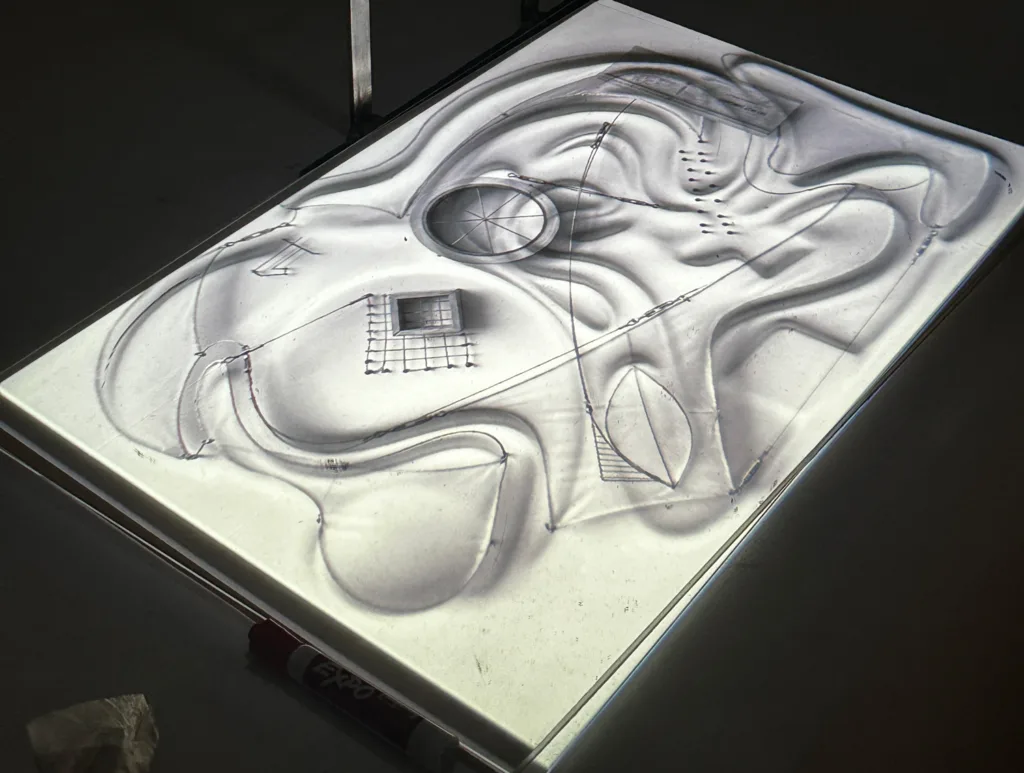
The design process often begins with “ill-defined problems,” requiring designers to deeply understand the problem in order to frame the right design question and develop possible solutions.[3] Various goals, constraints, and potential solutions are explored through many iterations and reflections.[4] In other words, the early stage of design is a time of productive uncertainty where the designer’s understanding of the design task evolves through engaging in the activity of design. Nigel Cross writes, “The ill-defined nature of design problems means that they cannot be solved simply by collecting and synthesing information, as the architect Richard MacCormac (1976) has observed: ‘I don’t think you can design anything just by absorbing information and then hoping to synthesise it into a solution. What you need to know about the problem only becomes apparent as you’re trying to solve it.’”
Most current generative AI tools short-circuit that process. The AI prompt interface usually asks for the relevant information in text or image input and, in one click, generates a proposed solution image. The image arrives immediately, fully rendered, before the designer has had a chance to understand what they are actually trying to make, and why. Because the photorealistic image appears so quickly, the productive uncertainty of early design is disappearing. Reasoning about function, spatial programming, structure, materiality, and context begins to orbit that initial image instead of being part of the development of the image. The solution space narrows at precisely the moment it should be most open.
This is what I have watched happen in my own courses, regardless of whether the syllabus explicitly incorporated AI or not. A student arrives with a spatial idea, something quite unresolved but worth developing. They open a tool, generate an image, and the session reorganizes itself around that output. Forty minutes later they are refining a Midjourney render, having often forgotten the most compelling aspects of their initial spatial idea. If the design direction feels misaligned with their initial goals, time pressures and assignment deadlines make it difficult to change course entirely.
Often, the AI tool has not forced a direction or made an explicit argument for one. It simply made a particular direction immediately visible, while alternatives were not visible and thus fell by the wayside. My students described it as forgetting their own design priorities, letting the tool steer rather than steering it themselves. Viewed through the lens of Jansson and Smith’s study, this may be a predictable cognitive response to an AI tool interface that was never designed with design cognition in mind.
– – –
There are other mismatches between how these tools work and what the design process actually requires.
Much of what skilled designers know is “tacit knowledge”: knowledge acquired through making and manifested in action rather than description. Michael Polanyi’s observation that “we can know more than we can tell” captures something current AI tools handle poorly.[5] Designers’ intuitions about proportion, scale, material behavior, and spatial quality resist verbalization by definition. Yet the dominant human–AI interaction paradigm asks designers to compress all of that embodied knowledge into a text or image prompt. In the process, the designer’s most relevant knowledge, the part that is hardest to articulate, becomes the knowledge the interface is least equipped to receive.

The appearance of competence compounds the problem. Fabrizio Dell’Acqua and colleagues describe what they call the “jagged technological frontier”: AI excels at some tasks while failing at others that appear similarly difficult, and the location of those failures is often invisible to the user.[6] One possible way to address this could be for the AI interface to provide a layer of annotation indicating which aspects of the outputs it is generating with high confidence or low confidence, so that the user might know what is at a higher risk of error.[7] In design, however, the challenge is rarely to distinguish between something obviously right and obviously wrong. More often, designers are choosing among gradations of better and worse solutions—options that are more or less appropriate to a specific brief, site, set of constraints, and intentions. When the distinction is not so binary, failures become harder to detect.
Prior design knowledge is what catches those failures. But the interface is not designed to activate that knowledge. It is designed to produce an image.
– – –
These problems further complicate each other. The lack of early exploration means the designer is committed to a direction before they have the information to evaluate it. The tacit knowledge issue means that the designer’s most relevant expertise never fully enters the process. The jagged frontier makes it difficult to know when the tool’s judgment can be trusted and when it cannot. Together, these issues point to a human–AI interaction paradigm that is structurally misaligned with what early design actually requires.
Yet the conversation about AI in the architecture, engineering, and construction (AEC) industry has focused almost entirely on inputs and outputs: whether the images are good, whether the style is coherent, how fast the tools are. The interaction itself deserves far more attention. When a designer receives a generated image during early ideation, what is the right next move? Generate another variation? Start over with a different prompt? Neither option corresponds to how early design works. Neither sufficiently supports the incremental reasoning and reflection through which design develops.
The problem extends beyond image generation. Tacit forms of knowledge, about material behavior, tolerance, and spatial experience, are difficult to incorporate into prompt-to-image workflows, and their absence becomes harder to paper over as outputs move closer to physical fabrication. In architectural education settings, I see this especially at the moment when students begin physicalizing their designs. Their first attempt at translating an AI-assisted form is almost always a 3D-printed model, even when instructed to use different materials, and the progress frequently stalls there. The 3D-printed plastic functions as a kind of “non-material,” allowing students to avoid questions of fabrication or scale. At this later stage of design, it becomes very difficult to re-incorporate tacit knowledge about architectural materials—illustrating how computational tools can come to structure design thinking itself.
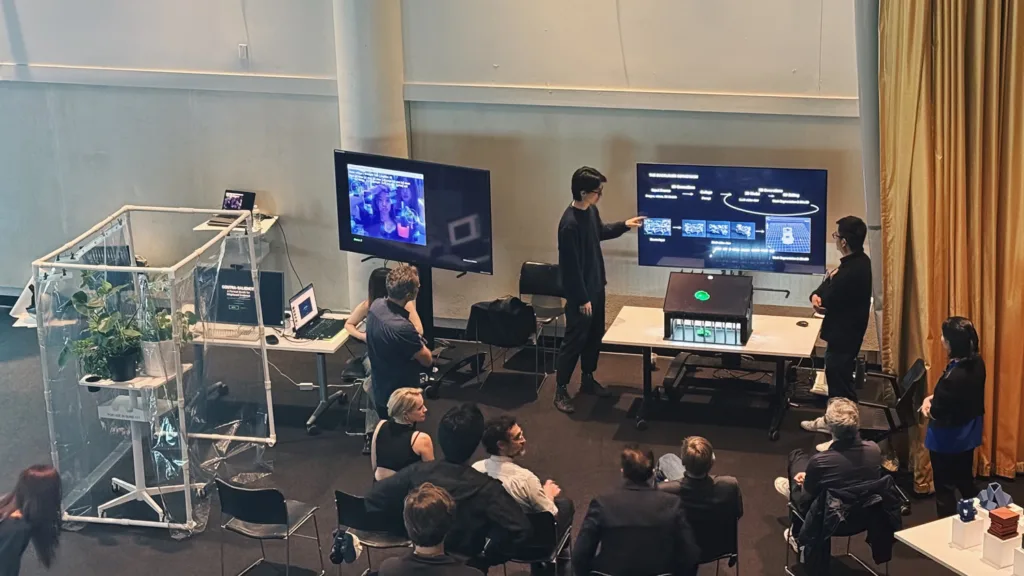
Design has a history of absorbing computational tools and then forgetting that the absorption happened. Early CAD changed how architects thought about drawing. BIM changed how they thought about coordination. Parametric modeling changed what kinds of forms felt possible. As David Kirsh argues, “tools . . . when manipulated, are soon absorbed into the body schema,” changing how we perceive and “conceive of our environment.”[8] Each time, the assumptions embedded in the tool eventually become invisible through familiarity. The advantage of this particular moment is that AI tools are still new enough for those assumptions to remain legible. That will not last. Commercial pressures reward whatever is fastest, most accessible, and monetizable, which is not necessarily aligned with what best supports design cognition in early-stage work.
We are currently fitting our design tasks to the available AI tools, rather than fitting the tools to the design task. We need to think more carefully about what our design tasks are and should be, and develop criteria for what good human–AI interaction in design looks like.
Adjacent computational design subfields offer a starting point. Human–robot collaboration research in architecture and construction has long discussed task complementarity, identifying what robots do well and what humans do well, and structuring workflows to match tasks to the appropriate party.[9] A similar framework could apply here. Generative AI far exceeds human capabilities in certain operations and is demonstrably limited in others, yet those boundaries do not necessarily align with how AI interfaces encourage designers to use these tools. The typical AI input interface makes it difficult for the designer’s own knowledge and intentions to remain an integral part of the process. What alternative inputs might exist beyond text or image, and how might human-AI interaction be reframed beyond prompting altogether? What does it mean for a designer to maintain design intentions while working with a generative system, and is there an ideal balance between maintaining intention and sustaining flexibility?
These are fundamental design questions. Yet they are not being investigated at the scale or with the urgency they require. What gets built next will depend, at least in part, on whether the design community develops the language to answer them before the terms of design are set by others.
[1] David G. Jansson and Steven M. Smith, “Design Fixation,” Design Studies 12, no. 1 (1991): 3–11, https://doi.org/10.1016/0142-694X(91)90003-F.
[2] Sajanee Wadinambiarachchi, Ryan M. Kelly, Siddharth Pareek, Qi Zhou, and Eduardo Velloso, “The Effects of Generative AI on Design Fixation and Divergent Thinking,” Proceedings of the CHI Conference on Human Factors in Computing Systems (2024): 1–18, https://doi.org/10.1145/3613904.3642919.
[3] Nigel Cross, “Design Ability,” Nordic Journal of Architectural Research 5, no. 4 (1992): 15–20.
[4] Other foundational texts describing the design process include John Gero’s “The Situated Function-Behaviour-Structure Framework” (2004), and Bryan Lawsons’s How Designers Think: The Designing Process Demystified (2006). The role of reflections in the design process is expressed in Donald Schön’s The Reflective Practitioner (1992).
[5] Michael Polanyi, The Tacit Dimension (Chicago: University of Chicago Press, 1966), https://press.uchicago.edu/ucp/books/book/chicago/T/bo6035368.html.
[6] Fabrizio. Dell’Acqua et al., “Navigating the Jagged Technological Frontier: Field Experimental Evidence of the Effects of Artificial Intelligence on Knowledge Worker Productivity and Quality,” Organization Science 37, no. 2 (2026): 403–423, https://doi.org/10.1287/orsc.2025.21838.
[7] A similar idea is explored in Ziwei Gu, Ian Arawjo, Kenneth Li, Jonathan K. Kummerfeld, and Elena L. Glassman, “An AI-Resilient Text Rendering Technique for Reading and Skimming Documents,” Proceedings of the CHI Conference on Human Factors in Computing Systems (2024): 1–22, https://doi.org/10.1145/3613904.3642699.
[8] David Kirsh, “Embodied Cognition and the Magical Future of Interaction Design,” ACM Transactions on Computer-Human Interaction 20, no. 1 (2013): 30.
[9] Mirosław J. Skibniewski and Shimon Y. Nof, “A Framework for Programmable and Flexible Construction Systems,” Robotics and Autonomous Systems 5, no. 2 (1989): 135–150; and Daniela Mitterberger et al., “Augmented Bricklaying,” Construction Robotics 4 (2020): 151–161, https://doi.org/10.1007/s41693-020-00035-8.